
Case Name: MOHSEEN V. THE STATE OF UTTAR PRADESH
Petition No.: SPECIAL LEAVE PETITION (CRIMINAL) NO.16696 of 2025
Neutral Citation: 2026 INSC 526
Date of Judgement: 22nd May, 2026
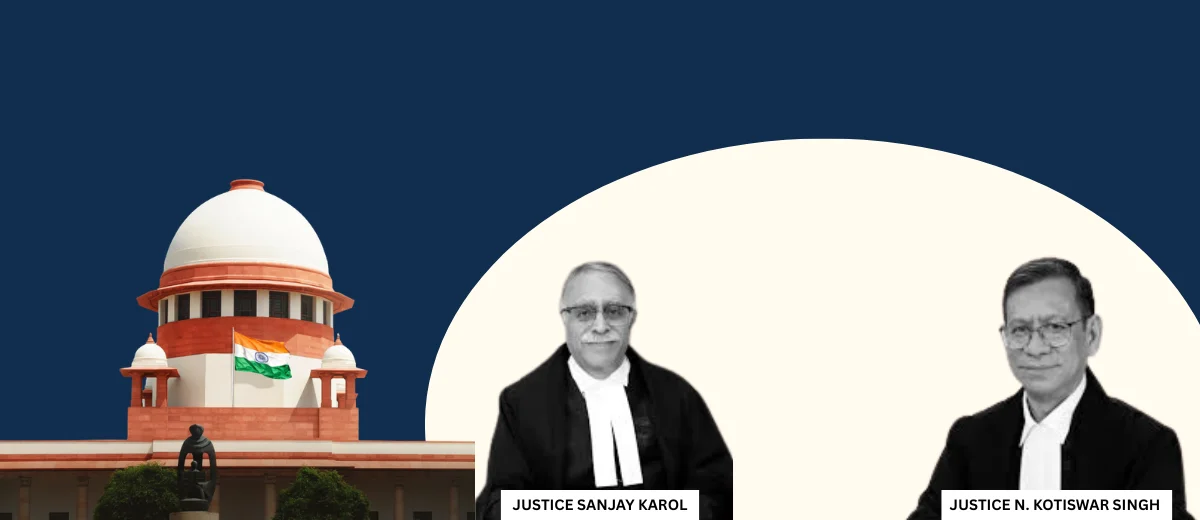
Coram: Honourable Mr Justice Sanjay Karol & Honourable Mr Justice Nongmeikapam Kotiswar Singh
Relevant Provisions: Article 136 of the Constitution of India; Sections 147, 148, 149, 323, 324, 452, 504, 506 and 307 of the Indian Penal Code, 1860; Sections 3, 25 and 27 of the Arms Act, 1959; Section 82 of the Code of Criminal Procedure, 1973.
INTRODUCTION
The present appeal revolved around the question whether a second order granting bail could be sustained in the absence of any fresh grounds or substantial change in circumstances, particularly when the earlier grant of bail had already been set aside by the Supreme Court and the accused had subsequently absconded despite directions to surrender. The Supreme Court answered the issue in the negative and held that a subsequent bail order must disclose fresh circumstances warranting release, failing which such an order would be legally unsustainable and liable to be set aside.The Supreme Court accordingly set aside the impugned bail order.
FACTS
The present appeal arose from the order passed by the High Court of Judicature at Allahabad whereby Respondent No. 2 accused Jeeshan was enlarged on bail in connection with offences committed under Sections 147, 148, 149, 323, 324, 452, 504, 506 and 307 of the Indian Penal Code [IPC] along with Sections 3, 25 and 27 of the Arms Act. The prosecution case emanated from a series of incidents linked to the murder of the Appellant’s brother, in which certain co-accused persons had already been convicted. It was alleged that the accused persons, including Respondent No. 2, persistently threatened the Appellant and his family to compel compromise in the murder case. On 12.05.2024, the accused allegedly intercepted and assaulted the victims with deadly weapons and thereafter chased them into their residence. CCTV footage allegedly captured Respondent No. 2 retrieving a country-made pistol, proceeding to the roof of an adjoining house and firing multiple shots. Eyewitnesses specifically attributed the act of firing to him. During investigation, Respondent No. 2 allegedly admitted to firing shots and concealing the weapon, pursuant to which a .315 bore pistol and cartridge were recovered at his instance.
The anticipatory bail application of Respondent No. 2 was initially rejected upon finding a prima facie case against him. Though subsequently granted regular bail, the same was set aside by this Court for ignoring his specific role. Despite cancellation of bail, he absconded for 42 days, leading to NBWs and Section 82 CrPC proceedings, before surrendering and obtaining bail again through the impugned order.
ISSUES
Whether a second order granting bail can be sustained in the absence of any fresh grounds or substantial change in circumstances, particularly where the earlier grant of bail had been set aside by the Supreme Court and the accused had subsequently absconded despite directions to surrender?
ARGUMENTS OF THE PARTIES
The Appellant contended that the High Court ignored this Court’s earlier order cancelling bail, overlooked the accused’s deliberate evasion of surrender despite NBWs and Section 82 proceedings, and failed to consider the CCTV footage, recovery of firearm, eyewitness statements and admitted role of Respondent No. 2 in firing shots and intimidating prosecution witnesses.
Per Contra, Respondent No. 2 contended that he was never declared a proclaimed offender and had surrendered within days of initiation of Section 82 CrPC proceedings while pursuing a review petition. It was argued that the CCTV footage did not conclusively establish firing, the injuries were simple in nature and insufficient for Section 307 IPC, and that a cross-case existed showing the complainant side as aggressors. Respondent No. 2 also placed reliance on the principle of parity with co-accused Aurangzeb, limited criminal antecedents and prolonged incarceration in order to justify his bail.
JUDGEMENT AND ANALYSIS
The Supreme Court held that the impugned order granting bail to Respondent No. 2 was legally unsustainable as the High Court had failed to apply the settled principles governing grant and cancellation of bail. The Court observed that the High Court completely ignored the earlier order passed by this Court cancelling the first bail granted to the accused and failed to identify any supervening circumstance or fresh ground justifying a subsequent grant of bail. Relying upon Ajwar v. Waseem & Anr., (2024) 10 SCC 768, the Court reiterated that an unreasoned or perverse order of bail is always open to interference where relevant material has been ignored or the gravity of the offence has not been duly considered.
The Court further held that the conduct of the accused after cancellation of bail was a significant factor militating against grant of bail. Despite being directed to surrender forthwith, Respondent No. 2 absconded for nearly 42 days, compelling issuance of NBWs and initiation of proceedings under Section 82 CrPC. Rejecting the plea that pendency of a review petition justified the delay, the Court held that filing of a review petition does not automatically stay the operation of the original order.
The Court also found that the High Court had ignored crucial material including CCTV footage, eyewitness statements and recovery of the country-made pistol and cartridge at the instance of the accused, all of which established a strong prima facie case. It reiterated that absence of firearm injuries does not negate an offence under Section 307 IPC where firing was allegedly done with intent to kill. The Court further rejected the plea of parity with co-accused Aurangzeb, relying upon Neeru Yadav v. State of U.P. [(2014) 16 SCC 508], wherein it was held that parity cannot be mechanically applied where the accused has a distinct and specific role.
The Court emphasized that while personal liberty is important, courts must equally protect victims and witnesses from intimidation. The Court also relied upon Mahipal v. Rajesh Kumar, [(2020) 2 SCC 118] and Prasanta Kumar Sarkar v. Ashis Chatterjee [(2010) 14 SCC 496] to reiterate that bail orders must be reasoned and must consider factors such as prima facie involvement, gravity of offence, likelihood of absconding and possibility of influencing witnesses. Consequently, the appeal was allowed and the bail granted to Respondent No. 2 was cancelled.
CONCLUSION
The Supreme Court concluded that the High Court’s order granting bail was unsustainable as it failed to consider the accused’s prior conduct, the earlier cancellation of bail, and the absence of any fresh or supervening circumstances. The court emphasised settled principles governing bail jurisprudence and held that liberty cannot override concerns of justice where prima facie evidence, abscondence, and witness intimidation exist. Accordingly, the appeal was allowed, and the bail granted to the respondent was cancelled, restoring judicial consistency.



 > Mon - Sat, 9:00 AM – 7:30 PM