
Case Name: GUJARAT WATER SUPPLY AND SEWERAGE BOARD v. SARYU PLASTICS PVT. LTD.
Petition No.: CIVIL APPEAL NOS. 769-770 OF 2026
Neutral Citation: 2026 INSC 552
Date of Judgement: 26th May, 2026
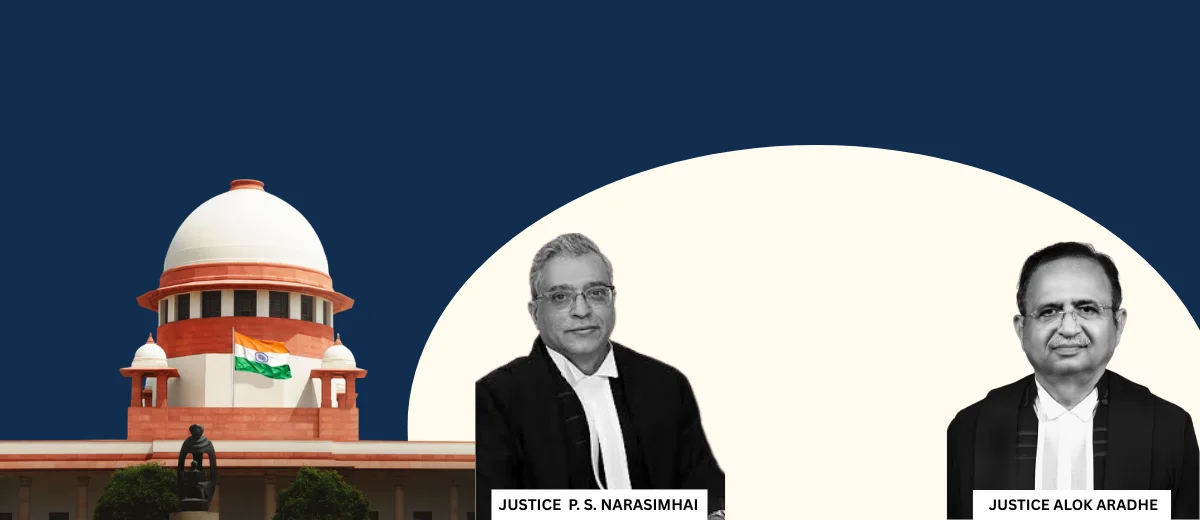
Coram: Honourable Mr Justice Pamidighantam Sri Narasimha & Honourable Mr Justice Alok Aradhe
Relevant Provisions: Sections 14, 29A, 33, and 34 of the Arbitration and Conciliation Act, 1996
INTRODUCTION
The Supreme Court in the present case examined the limited scope of correction powers under Section 33(1)(a) of the Arbitration and Conciliation Act, 1996. The Court considered whether an arbitral award granting simple interest during the pendente lite period could subsequently be modified to grant compound interest on the ground that the original reference to simple interest was merely inadvertent. The judgment is significant because it reiterates that the corrective jurisdiction under Section 33 is confined strictly to clerical, computational, typographical, or arithmetical errors and cannot be used as a device for substantive review or alteration of the merits of an arbitral award.
FACTS
The appellant was constituted under the Gujarat Water Supply and Sewerage Board Act, 1978 for providing water supply and sanitation services in the State of Gujarat. The respondent was engaged in the manufacture and supply of PVC pipes and was registered as a small-scale industrial unit. The Board had awarded several rate contracts to the respondent company for supply of PVC pipes. Subsequently, an internal audit revealed alleged irregularities and excess payments made to suppliers.
The parties entered into an arbitration agreement which stipulated that the arbitrator’s mandate would initially remain valid for six months. The arbitration proceedings continued over a prolonged period of 3 years. Throughout the proceedings, repeated extensions were granted. The arbitral record reflected multiple instances where the Board either failed to attend proceedings, delayed filing replies, or failed to provide factual clarifications and documents sought by the arbitrator. The arbitrator repeatedly noted that the Board’s conduct was causing delay in conclusion of proceedings.
In 2015, the arbitrator passed an award partly allowing the respondent’s claims. The award granted approximately Rs. 1.01 crores along with simple interest at the rate of 21.675% per annum for the pendente lite period. The award further granted compound interest from the date of the award till realization. The respondent company filed an application under Section 33 of the Arbitration and Conciliation Act seeking correction of the award by substituting the expression “simple interest” with “compound interest” in the operative portion relating to pendente lite interest.
The arbitrator declined to adjudicate upon the application because proceedings under Section 34 were already pending before the Commercial Court. Thereafter, the Commercial Court, by order, modified the award and granted compound interest for the pendente lite period as well. The Board challenged the modification before the Gujarat High Court. The High Court dismissed the appeals filed by the Board. Aggrieved thereby, the Board approached the Supreme Court.
ISSUES
1. Whether the arbitral mandate validly subsisted at the time when the arbitral award was passed?
- Whether the award had been dispatched after receipt of the Board’s objection regarding expiry of mandate?
- Whether the arbitral proceedings were conducted in violation of principles of natural justice?
- Whether the Commercial Court possessed jurisdiction under Section 33(1)(a) of the Arbitration and Conciliation Act, 1996 to substitute simple interest with compound interest in the arbitral award?
ARGUMENTS OF THE PARTIES
The appellant Board argued that the mandate of the arbitrator had expired and that the Board had never consented to any further extension. It was submitted that the arbitrator proceeded to pass the award despite expiry of his mandate. The Board further argued that the arbitral proceedings violated principles of natural justice because the Board was not afforded an effective opportunity of hearing. It was also contended that the Commercial Court had acted beyond its jurisdiction by substantially modifying the award through review proceedings. According to the Board, the original award imposed liability of approximately Rs. 30.38 crores, whereas the modification granting compound interest increased the liability to approximately Rs. 144.93 crores. Such a drastic enhancement, it was argued, could never be treated as a mere clerical correction under Section 33.
The respondent company, on the other hand, contended that the Board had participated throughout the arbitral proceedings without objecting to extension of the arbitrator’s mandate and therefore could not subsequently challenge the award on that ground. It was argued that the Board’s conduct amounted to acquiescence and waiver. It also contended that the arbitrator had intended to award compound interest and that the use of the expression “simple interest” in the operative portion of the award was inadvertent. It was submitted that the Commercial Court rightly exercised corrective jurisdiction to rectify the error and bring the operative portion in conformity with the arbitrator’s true intention.
JUDGEMENT AND ANALYSIS
For the first issue, the Court examined whether the arbitrator’s mandate had subsisted when the award was delivered. The Court noted that although the arbitration agreement initially prescribed a six-month period, the parties repeatedly participated in proceedings and consented to extensions over several years. The Court observed that the Board merely communicated its inability to attend the hearing fixed on 15th October 2015 and did not object that the arbitrator’s mandate had expired. The Court therefore held that the Board had tacitly agreed to extension of the mandate and had acquiesced in continuation of proceedings.
The Bench emphasised the principles of party autonomy and minimal judicial intervention underlying arbitration law. It noted that prior to the insertion of Section 29A, there existed no statutory requirement prescribing a particular form for extension of an arbitrator’s mandate. Consequently, the issue was governed by contractual intention. On the issue of dispatch of the award, the Court rejected the Board’s contention that the award had been dispatched only after receipt of its objection. The Court relied upon courier receipts demonstrating that the award had already been. Hence, the Court held that the award was delivered before the Board raised objections regarding mandate.
The Court next dealt with the allegation of violation of natural justice. After examining the chronology of proceedings, the Bench found that the Board itself had repeatedly delayed the arbitration by failing to file replies, failing to produce documents, seeking repeated extensions, and remaining absent from proceedings. The Court observed that the Board had been granted numerous opportunities over more than three and a half years and could not convert its own dilatory conduct into a grievance regarding denial of fair hearing. The Court held that the arbitrator was justified in proceeding with the award when the Board failed to attend the hearing fixed at its own request. Accordingly, the arbitral proceedings were held to be consistent with principles of natural justice.
With respect to the scope of Section 33(1)(a) of the Arbitration and Conciliation Act, the Court held that the Commercial Court had exceeded its jurisdiction by substituting simple interest with compound interest. The Court found that the arbitrator had consciously granted simple interest during the pendente lite period while separately granting compound interest post-award. The Bench held that characterisation of interest as simple or compound pertains to the merits and equities of the dispute and cannot be treated as a clerical or typographical mistake. The Court observed that replacing simple interest with compound interest would amount to substantive modification of the award and not mere correction.
The Court relied upon the decision in State of Arunachal Pradesh v. Damani Construction Co. (2007) 10 SCC 742 where it was held that Section 33 does not permit review of an arbitral award and is confined strictly to correction of clerical and arithmetical errors. The Court further referred to Gayatri Balasamy v. ISG Novasoft Technologies Ltd. (2025) 7 SCC 1 which dealt with the limited scope of judicial interference with arbitral awards. Though Gayatri Balasamy recognized limited powers of modification in specific circumstances, the present judgment clarified that such powers cannot be expanded into a mechanism for substantive review under the guise of correction proceedings.
The Court ultimately held that the Commercial Court’s exercise of review jurisdiction effectively converted Section 33 into an appellate mechanism, contrary to the structure and philosophy of the Arbitration and Conciliation Act. The modification was therefore quashed. The Supreme Court set aside the judgments of the Gujarat High Court and the Commercial Court which had modified the award and converted simple interest into compound interest, thereby drastically increasing the liability of the Gujarat Water Supply and Sewerage Board from approximately Rs. 30.38 crores to Rs. 144.93 crores.
CONCLUSION
The Supreme Court reaffirmed that Section 33 of the Arbitration and Conciliation Act, 1996 is a narrowly tailored corrective provision confined only to clerical, typographical, computational, or arithmetical mistakes. It cannot be invoked to reopen or substantially modify the merits of an arbitral award. The Court held that conversion of simple interest into compound interest constitutes a substantive alteration affecting the financial liability of parties and therefore falls outside the permissible scope of Section 33 corrections. The judgment reinforces the principle of finality of arbitral awards and limits judicial intervention. Accordingly, the Supreme Court restored the original award and held that Saryu Plastics Pvt. Ltd. was entitled only to simple interest at the rate of 21.675% for the pendente lite period, while setting aside the modification granting compound interest.




 > Mon - Sat, 9:00 AM – 7:30 PM