
Case Name: MOHAMMAD HANIF JAINUM KHALIFA V. THE STATE OF KARNATAKA
Petition Number: CRIMINAL APPEAL NO. 2902 OF 2026
Neutral Citation: 2026 INSC 565
Date of Judgment: 27.05.2026
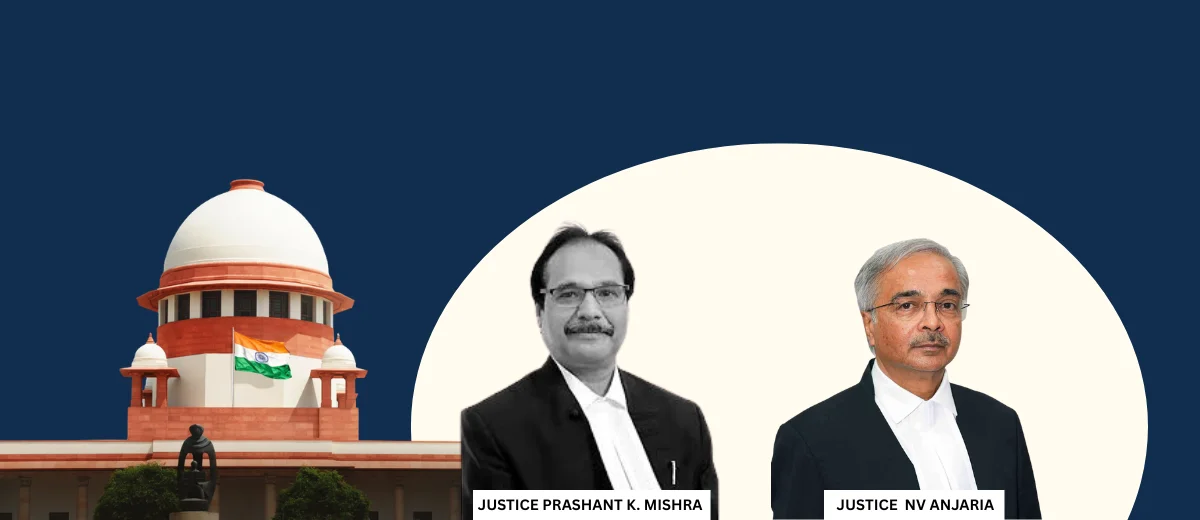
Coram: HON’BLE JUSTICE MR. PRASHANT KUMAR MISHRA & HON’BLE MR. JUSTICE N.V. ANJARIA
Relevant Provisions: Sections 279 of the Indian Penal Code and Section 304A of the Indian Penal Code.
INTRODUCTION
The present appeal arose from the judgment of conviction and sentence passed against the appellant, a KSRTC bus driver, under Sections 279 and 304A of the Indian Penal Code (IPC) for an alleged road accident in which a passenger fell from a moving bus while alighting and subsequently died. The appellant challenged the concurrent findings of the courts below, contending that the incident was a mere accident and that no rash or negligent act on his part was proved beyond reasonable and argued that the courts below misappreciated evidence and failed to establish the essential ingredients of criminal negligence under law.
FACTS
The present appeal centered around the correctness of the conviction and sentence imposed on the appellant, a KSRTC bus driver, arising from a road accident in which a passenger fell from a moving bus while alighting and later succumbed to her injuries. The core controversy concerned whether the appellant’s act of allegedly moving the bus before passengers had safely disembarked amounted to rash and negligent driving under Sections 279 and 304A of the IPC, or whether the incident was an unfortunate accident attributable to the deceased’s own hurried attempt to alight. The trial court, relying primarily on the consistent testimonies of PW1, PW4, and PW5, held that the appellant started the bus without ensuring passenger safety, thereby constituting negligence, and convicted him accordingly. The appellate court affirmed both conviction and sentence. In revision, however, the High Court partially interfered, maintaining the conviction but setting aside the separate sentence under Section 279 IPC on the ground of merger, while sustaining the sentence under Section 304A IPC. Aggrieved, the appellant approached this Court questioning the sustainability of the concurrent findings of rash and negligent driving and the legality of sustaining conviction on the available evidence.
ISSUE
Whether, in the absence of clear attendant circumstances establishing rashness or negligence, a conviction under Section 304A of the IPC can be sustained on mere presumption or conjecture?
JUDGEMENT AND ANALYSIS
The Supreme Court was called upon to determine whether the appellant-bus driver could be held criminally liable under Sections 279 and 304A IPC for the death of a passenger who fell while alighting from a KSRTC bus and subsequently succumbed to her injuries.
The prosecution principally relied upon the testimonies of PW1, PW4 and PW5 to contend that the appellant had moved the bus before the passenger had safely disembarked, thereby causing her fall. However, the Court attached considerable significance to the testimony of the bus conductor (PW6), who stated that he had first signalled the driver to stop the bus, ensured that passengers had alighted, and only thereafter gave the signal to proceed. The Court observed that the movement of a public bus is ordinarily regulated by the conductor’s signals and that the appellant had acted strictly in accordance with those instructions. In the absence of any evidence showing that the appellant acted independently, rashly, or negligently, criminal liability could not be fastened upon him.
The court relied on principles laid down in Ravi Kapur v. State of Rajasthan [(2012) 9 SCC 284] and State of Karnataka v. Satish [(1998) 8 SCC 493], to reiterate negligence under Section 304A IPC cannot be presumed merely from the occurrence of an accident; it must be established from clear and cogent attendant circumstances. The Court revisited the concepts of “culpable rashness” and “culpable negligence”, emphasising that criminal negligence arises where an act is done with the consciousness that harmful or illegal consequences may ensue, but with the hope that they will not occur, or with the belief that adequate precautions have been taken to prevent them. It further observed that recklessness represents a higher degree of carelessness and involves acting with disregard for, or indifference to, the possible harmful consequences of one’s conduct.
Applying these principles, the Court held that the appellant’s conduct could not be characterised as reckless or negligent. The decision to move the bus was preceded by due consideration and was guided by the conductor’s signal, upon which the driver was entitled to rely. The appellant had no reason to believe that any passenger was still in the process of alighting when the bus was moved. Consequently, the essential ingredients of culpable rashness or negligence were not established. The Court also held that the doctrine of res ipsa loquitur had no application to the facts of the case.
The Court further noted that the possibility of the deceased slipping due to her own movement could not be ruled out, and the prosecution version did not conclusively establish criminal negligence on the part of the appellant. Finding that the courts below had committed a manifest error in appreciating evidence, the Supreme Court set aside the conviction and acquitted the appellant of all charges.
CONCLUSION
The Supreme Court ultimately held that the prosecution had failed to establish beyond reasonable doubt that the appellant-driver acted with rashness or negligence as required under Sections 279 and 304A IPC. Emphasising that criminal negligence cannot be inferred on conjecture, the Court found that the evidence of the conductor and surrounding circumstances did not support the prosecution version. It reiterated that the mere occurrence of an accident is insufficient to fasten criminal liability in the absence of clear attendant circumstances proving culpable negligence. Accordingly, the Court set aside the concurrent findings of the courts below and acquitted the appellant of all charges, granting him relief.


 > Mon - Sat, 9:00 AM – 7:30 PM