Case Name: B.S. LALITHA v. BHUVANESH
Petition No.: SLP (C) NO.23709 OF 2024
Neutral Citation: 2026 INSC 499
Date of Judgment: 15th May 2026
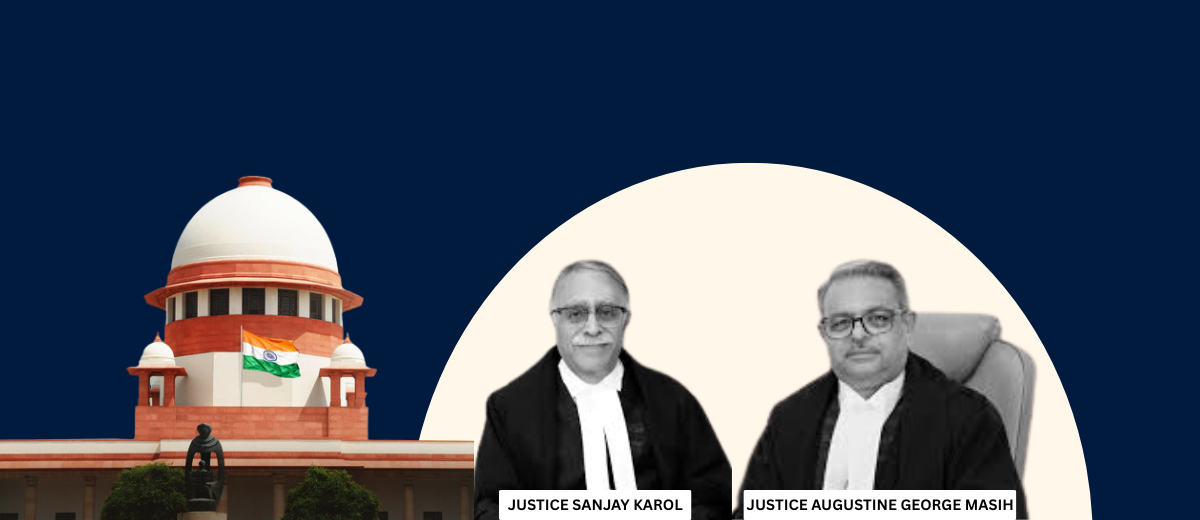
Coram: Honourable Mr Justice Sanjay Karol and Honourable Mr Justice Augustine George Masih
Relevant Provisions: Sections 6 and 8 of the Hindu Succession Act, 1956; Order VII Rule 11 and Section 115 of the Code of Civil Procedure, 1908; Section 11 CPC (Res Judicata).
INTRODUCTION
The Supreme Court, in a matter concerning daughters’ inheritance rights under the Hindu Succession Act, held that Section 6(5) of the Hindu Succession Act, 1956, does not bar daughters from maintaining a partition suit claiming inheritance rights as Class I heirs under Section 8 of the Act. The Court clarified that the 2005 amendment granting coparcenary rights to daughters by birth does not extinguish or dilute the independent right of daughters to inherit the share of their father who died intestate. The Court further held that a partition deed executed exclusively among sons before 20 December 2004 cannot automatically defeat the daughters’ statutory rights in the father’s share.
FACTS
The dispute arose from the estate of one B.M. Seenappa, who died intestate on 6 March 1985, leaving behind his widow, three daughters, and four sons. The appellants before the Supreme Court were the daughters of the deceased. After the death of the propositus, the defendants contended that an oral partition had taken place among the sons in 1985 pursuant to oral instructions allegedly given by the deceased before his death. It was further claimed that in 1988, the daughters were paid money and had signed a family arrangement document called a “Palupatti”, thereby consenting to the partition among the brothers.
The daughters disputed the legality and validity of these transactions. According to them, the only relevant partition was a registered partition deed dated 16 June 2000 executed between the widow and four sons, whereby the properties were divided exclusively among the sons and the mother without granting any share to the daughters. The daughters asserted that they were neither parties to the deed nor informed about it.
In 2007, the daughters instituted a partition suit seeking equal division of the suit properties and claiming a 1/8th share each as Class I heirs of their deceased father. They pleaded that the father had died intestate and that his share therefore devolved equally among all Class I heirs under Section 8 of the Hindu Succession Act.
The defendants filed an application under Order VII Rule 11 of the CPC seeking rejection of the plaint on the ground that the suit was barred under Section 6(5) of the Hindu Succession Act, as the 2000 partition deed was treated as a pre-2004 partition. The trial court initially rejected the plaintiff’s claim in 2008. However, in 2013, the Karnataka High Court set aside that order and restored the suit, holding that even if the daughters were denied coparcenary rights, they could still maintain the suit as Class I heirs because the father had died intestate.
Subsequently, in 2021, the legal representatives of one of the sons filed a second application under Order VII Rule 11 of the CPC, again seeking rejection of the plaint on substantially similar grounds. The trial court dismissed this second application, finding it barred by res judicata. However, in 2024, the Karnataka High Court allowed the revision petition and rejected the plaint, leading the daughters to approach the Supreme Court.
ISSUES
1. Whether the second application under Order VII Rule 11 CPC seeking rejection of the plaint was barred by the principle of res judicata, having regard to the earlier application on the same issue, which had already been decided by the High Court and had attained finality?
2. Whether Section 6(5) of the Hindu Succession Act operates as a complete statutory bar to the institution of a partition suit where a partition deed had been executed prior to 20 December 2004?
3. Whether daughters possess an independent inheritance right under Section 8 of the Hindu Succession Act as Class I heirs of a father who died intestate, irrespective of the coparcenary rights introduced by the 2005 amendment?
ARGUMENTS OF THE PARTIES
The appellants (daughters) argued that the second application under Order VII Rule 11 CPC was clearly barred by res judicata, as the identical issue had already been adjudicated by the High Court in 2013 and the said order had attained finality. They contended that all defendants were litigating under the same title and shared a common interest, and therefore, the legal representatives of one son could not reopen an issue already conclusively decided.
The appellants further argued that Section 6(5) is merely a saving clause intended to protect certain past partitions from the retrospective operation of the 2005 amendment. It does not create a jurisdictional bar preventing daughters from filing a partition suit. According to them, whether the 2000 partition deed was valid, binding, or capable of defeating their inheritance rights was a disputed question requiring trial and evidence.
The appellants also contended that their rights were not dependent on the 2005 amendment. Since their father died intestate in 1985, leaving behind daughters who were Class I heirs, his share devolved under Section 8 of the Hindu Succession Act by intestate succession. Therefore, their entitlement arose independently of coparcenary rights and could not be extinguished by Section 6(5).
The respondents-defendants argued that the registered partition deed dated 16 June 2000 constituted a valid partition protected under Section 6(5) of the Hindu Succession Act. They relied heavily on Vineeta Sharma v. Rakesh Sharma (2020) 9 SCC 1 to contend that pre-2004 partitions were not subject to reopening. It was also argued that the daughters had earlier accepted money under the Palupatti arrangement and had relinquished their claims. The respondents further argued that res judicata did not apply because the second application was filed by different parties and because Vineeta Sharma constituted a subsequent change in law, overriding the earlier 2013 order.
JUDGEMENT AND ANALYSIS
Addressing the first issue, the Supreme Court held that the second application seeking rejection of the plaint was clearly barred by the principle of res judicata. The Court observed that the issue raised in the second application was substantially identical to the issue decided earlier in the first Order VII Rule 11 proceedings, where the High Court in 2013 had already held that the daughters’ suit was maintainable because their father had died intestate and they possessed rights in his share under Section 8 of the Hindu Succession Act. The Court explained that the doctrine of res judicata applies not only between separate suits but also between different stages of the same litigation. Once a competent court decides an issue, it cannot be re-agitated at a subsequent stage of the same proceedings.
The Supreme Court rejected the High Court’s reasoning that res judicata was inapplicable merely because the second application had been filed by different defendants. The Court observed that all defendants shared a common interest in resisting the partition suit and were litigating under the same title. Where parties litigate bona fide in respect of a common right, the decision binds all persons interested in that right.
The Court also rejected the argument that Vineeta Sharma constituted a change in law sufficient to displace res judicata. It clarified that Vineeta Sharma dealt only with daughters’ coparcenary rights under amended Section 6 and did not alter the settled legal position that daughters inherit as Class I heirs under Section 8 when a father dies intestate. On this issue, the Court specifically held that the second Order VII Rule 11 application was impermissible because the earlier High Court order had conclusively determined that the suit was maintainable and that conclusion had attained finality.
Regarding the second issue, the Supreme Court held that Section 6(5) of the Hindu Succession Act is merely a saving clause and does not constitute a jurisdictional bar to the courts entertaining partition suits. Section 6(5) was enacted only to protect completed pre-2004 partitions from being disturbed by the newly conferred coparcenary rights of daughters. It does not extinguish pre-existing inheritance rights, nor does it bar institution of suits.
The Court drew a crucial distinction between a “bar” and a “saving clause”. A statutory bar prevents the court from entertaining a suit altogether, whereas a saving clause merely provides a defence on the merits which must be proved during trial. The Court observed that whether a valid partition within the meaning of Section 6(5) had actually taken place, and whether such partition was binding upon daughters who were not parties to it, were disputed questions of fact and law requiring adjudication at trial.
The Court held that the Karnataka High Court had erroneously equated the existence of a registered partition deed with conclusive proof that the partition was valid and binding. The Supreme Court clarified that the daughters had specifically challenged the validity of the partition deed, alleging that it was executed in secret without their knowledge or consent. Such questions could not be decided at the threshold stage under Order VII Rule 11 CPC. Therefore, the Court conclusively held that Section 6(5) does not bar partition suits and that the validity and binding nature of a partition deed must be examined through proper trial and evidence.
For the final issue of whether daughters possess an independent right under Section 8, unaffected by Section 6(5), the Supreme Court emphatically held that daughters possess an independent statutory right under Section 8 of the Hindu Succession Act as Class I heirs when their father dies intestate. This right accrues independently of the 2005 amendment and remains unaffected by Section 6(5).
Under the original law, where a Hindu male died leaving behind female Class I heirs, such as daughters, his interest in coparcenary property would devolve not by survivorship but through intestate succession under Section 8. A notional partition was deemed to take place immediately before the father’s death, and his share would devolve equally upon all Class I heirs.
Applying this principle to the present case, the Court held that since the father died intestate in 1985, leaving behind daughters, the daughters acquired inheritance rights in his share at that very moment under Section 8. These rights predated the 2005 amendment by nearly two decades.
The Court clarified that Section 6(5) only protects pre-2004 partitions from the operation of the new coparcenary regime introduced in 2005. It does not override or extinguish the independent devolution that occurs under Section 8 upon intestate death. The Court further held that even assuming the 2000 partition deed was valid and protected under Section 6(5), the daughters’ rights in the father’s share were not automatically extinguished. Whether the partition deed could bind daughters who were not parties to it was itself a matter requiring adjudication during trial.
On this issue, the Court expressly held that daughters continue to enjoy inheritance rights as Class I heirs under Section 8 independently of the 2005 amendment, and such rights cannot be defeated merely because a partition deed was executed among sons before 20 December 2004.
CONCLUSION
The Supreme Court allowed the appeal and set aside the Karnataka High Court’s 2024 judgment rejecting the plaint. The Court restored the trial court’s order dismissing the second Order VII Rule 11 application and directed that the partition suit proceed expeditiously on the merits. The judgment is a significant clarification of the relationship between Sections 6 and 8 of the Hindu Succession Act. It establishes that daughters’ inheritance rights as Class I heirs under Section 8 are distinct from and independent of the coparcenary rights introduced through the 2005 amendment.


 > Mon - Sat, 9:00 AM – 7:30 PM