
Case Name: THE ORIENTAL INSURANCE COMPANY LIMITED V. KALU RAM AND OTHERS
Petition No.: CIVIL APPEAL NO. 8706 OF 2026 [ARISING OUT OF S.L.P. (CIVIL) NO. 2360 OF 2023]
Neutral Citation: 2026 INSC 653
Date of Judgement: 23.06.2026
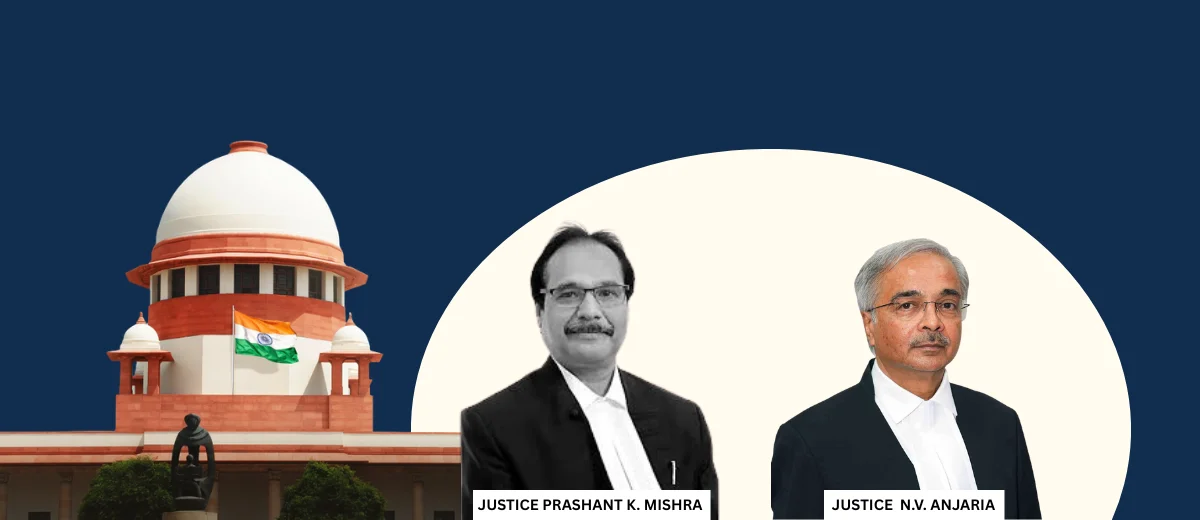
Coram: Hon’ble Mr. Justice Prashant Kumar Mishra & Hon’ble Mr. Justice N.V. Anjaria
Relevant Statutes & Provisions: Sections 166 and 140 of Motor Vehicles Act, 1988
INTRODUCTION
The Supreme Court considered cross-appeals arising from a motor accident compensation claim under the Motor Vehicles Act, 1988 (hereinafter referred as “1988 Act”). The case concerned the death of a 20-year-old Chartered Accountancy student who lost his life after a car collided with a stationary truck negligently parked on a Delhi roadway without warning indicators. The Court examined issues relating to negligence, contributory negligence, and the assessment of compensation for a deceased student with promising professional prospects. Reaffirming the principle of “just compensation,” the Court upheld the award granted by the Tribunal and further enhanced it by granting filial consortium to the deceased’s parents.
FACTS
The case arose from a motor vehicle accident that occurred on 11th June 2013 near Andrews Ganj Bus Stop, Delhi. Akash Kumar, a 20-year-old Chartered Accountancy (Final) student undergoing articleship, was travelling in a Wagon-R car when it collided with a stationary truck. The claimant alleged that the truck had been negligently parked on the roadway without parking lights, reflectors, or warning signs, resulting in the fatal injuries suffered by the deceased. Following registration of an FIR and filing of a charge sheet against the truck driver, the deceased’s parents instituted a claim petition under Sections 166 and 140 of 1988 Act. The insurer contested liability, attributing negligence to the car driver and disputing the assessment of compensation based on the deceased’s future earning potential. The insurer approached the Court assailing the concurrent findings on negligence and the quantum of compensation, whereas the claimants seek enhancement of the compensation awarded, giving rise to the present cross-appeals for consideration.
ISSUE
The primary issue in this case was whether compensation could be enhanced on the ground that the future earning potential of the deceased was not adequately assessed and that compensation under the conventional heads has not been fully granted?
ARGUMENTS OF THE PARTIES
The insurer contended that the Tribunal and the High Court erred in holding the truck driver solely negligent. It argued that the truck had been parked on the extreme left side of the road due to a puncture and that the accident occurred because of the rash and negligent driving of the Wagon-R. The insurer further submitted that the compensation awarded was excessive, as the Tribunal had assessed the deceased’s income on speculative assumptions regarding his future professional success and earning capacity.
The claimant argued that the truck had been negligently stationed on the road without parking lights, reflectors, indicators, or warning signs, making it invisible in the darkness and causing the accident. They supported the finding of negligence against the truck driver and sought enhancement of compensation, contending that the deceased was a Chartered Accountancy (Final) student with exceptional professional prospects whose future earning potential had not been adequately considered. They also claimed compensation under the conventional heads, including a filial consortium.
JUDGEMENT AND ANALYSIS
While addressing the challenge with regard to concurrent findings on negligence, the Court reiterated that It is well settled that this Court, in exercise of jurisdiction under Article 136 of the Constitution of India, does not ordinarily interfere with concurrent findings of fact unless such findings are shown to be perverse, manifestly erroneous or based on no evidence. Finding no infirmities in the present case, the challenge laid by the insurer to the finding of negligence could not succeed.
While addressing the primary issue with regard to the quantum of compensation, the Court referred to National Insurance Co. Ltd. v. Pranay Sethi (2017) 16 SCC 680, wherein this Court had explained that the addition towards future prospects is intended to be made to the established income of the deceased so as to account for the normal rise in income over time, and even in the case of self-employed or fixed-salary individuals, such addition is structured as a standardised percentage over the proven income. The Court held that the overall compensation awarded remained within the bounds of just compensation and did not warrant reduction. The Court also relied upon Magma General Insurance Co. Ltd. v. Nanu Ram (2018) 18 SCC 130, which held that the entitlement of parents in the case of death of an unmarried son or daughter is to be included under the head of ‘filial consortium’.
The Court highlighted that MV Act being a beneficial legislation, it is the duty of the Court to ensure that just compensation is awarded, even if a legitimate conventional head has been omitted by the courts below. The Court observed that the claimants, being the parents of the deceased unmarried son, are entitled to compensation under the head of ‘filial consortium’, and categorically held that the omission of the Tribunal and the High Court in this regard required correction, and accordingly in addition to the compensation already awarded, the claimants were entitled to an amount of Rs. 40,000/- each towards filial consortium, in terms of the principles, governing compensation under the conventional heads.
CONCLUSION
The Supreme Court reaffirmed that liability in motor accident claims must be determined on the basis of credible evidence and that unsupported allegations of contributory negligence cannot defeat a claim for compensation. Upholding the concurrent findings of the Tribunal and the High Court, the Court held the truck driver solely responsible for the accident. It further emphasized that the assessment of compensation under the Motor Vehicles Act should be guided by the principle of “just compensation,” particularly where a young individual with significant professional potential has lost his life. By awarding a filial consortium to the deceased’s parents, the Court ensured a more complete and equitable measure of compensation.


 > Mon - Sat, 9:00 AM – 7:30 PM