Case Name: KAMAL PRASAD DUBEY VERSUS THE STATE OF MADHYA PRADESH AND OTHERS
Petition Number: Special Leave Petition (C) Nos. 13578-13579 of 2020
Neutral Citation: 2026 INSC 353
Date of Judgement: 10.04.2026
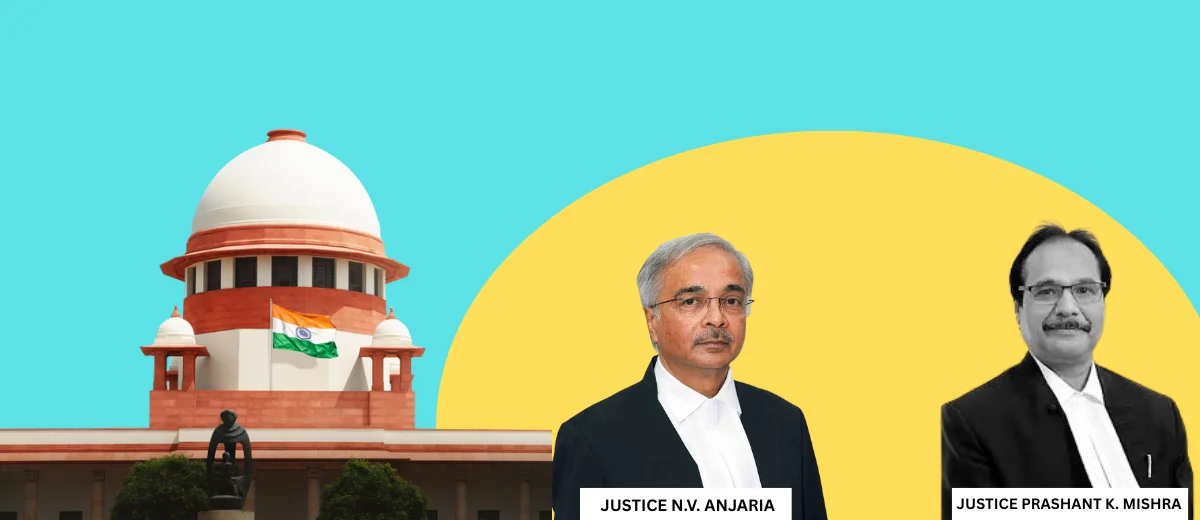
Coram: HON’BLE MR JUSTICE PRASHANT KUMAR MISHRA & HON’BLE MR JUSTICE N.V. ANJARIA
INTRODUCTION
The appeal was filed by an employee of a Primary Agriculture Credit Cooperative Society challenging the judgment of a Division Bench of the Madhya Pradesh High Court. The Division Bench had reversed a Single Judge’s order and upheld the Registrar of Cooperative Societies’ decision to reject the appellant’s promotion. The Supreme Court examined the arbitrary and discriminatory refusal by the Registrar to relax the appellant’s educational qualifications, especially when identical relaxations were granted to similarly situated co-employees, thereby assessing the State’s action against the touchstone of Articles 14 and 16 of the Constitution.
FACTS
The appellant was appointed permanently as a Sahayak Samiti Sevak (Assistant Society Manager) in 1987. At the time of his appointment, the required educational qualification for promotion to Society Manager was a Higher Secondary qualification, which the appellant possessed. He served with an unblemished record for 28 years. In 2013, new service rules were introduced requiring a graduation degree and a computer diploma for the post of Society Manager. However, Rule 19-A of the relevant Rule contained a proviso allowing the Registrar to relax this educational qualification based on an employee’s special experience, competence, or seniority.
Recognizing his 28 years of clean and competent service, the Society’s Board of Directors unanimously passed a resolution in July 2015 recommending the appellant’s promotion and seeking a relaxation of the new educational criteria. The General Body subsequently ratified this. However, on June 7, 2016, the Commissioner-cum-Registrar cryptically rejected this proposal without assigning any reasons. Concurrently, the Registrar approved the promotions of two other similarly situated employees who also only possessed a Higher Secondary qualification but were granted the relaxation. The appellant challenged the rejection. The Single Judge allowed his petition, citing parity and discrimination. However, the Division Bench reversed this, stating the Registrar was within his powers to decline the relaxation since the appellant lacked the baseline qualification, prompting the present appeal to the Supreme Court.
ISSUE
Whether the Registrar’s refusal to grant a relaxation in educational qualifications to the appellant, while granting the same to similarly situated employees, was arbitrary, discriminatory, and violative of Articles 14 and 16 of the Constitution?
ARGUMENTS OF THE PARTIES
The Appellant argued that the Board of Directors had validly exercised its discretion to recommend relaxation based on his 28 years of unblemished service. He contended that the Registrar’s cryptic rejection was patently discriminatory, as two other employees with the exact same educational qualifications (Higher Secondary) were granted the relaxation and promoted during the same period.
The Respondents argued that under the 2013 Rules, a graduation degree was a mandatory prerequisite for promotion to Society Manager. They contended that since the appellant did not possess this baseline qualification at the time of the proposal, the Registrar was well within his jurisdiction and discretionary powers to decline the relaxation.
JUDGEMENT AND ANALYSIS
The Hon’ble Supreme Court allowed the appeals, set aside the Division Bench’s orders, and restored the Single Judge’s decision in favour of the appellant. The Court began with the profound observation that “Discrimination is the other name of injustice.” It found that the Board of Directors had validly resolved to extend the relaxation to the appellant based on his vast experience.
The Court heavily emphasized the undeniable discrimination meted out to the appellant. The appellant and the other two employees formed a “homogeneous class” of employees possessing only a Higher Secondary qualification but having substantial work experience. The Registrar’s act of approving the relaxation for the other two employees while discarding the appellant’s identical case was held to be manifestly arbitrary. The Court clarified that this was not a case of claiming “negative equality”; rather, because the relaxation was legally permissible under the Rules, the appellant was legitimately entitled to positive equal treatment.
The Court held that the denial of equal treatment to the appellant was discriminatory and violative of Articles 14 and 16 of the Constitution of India, as it amounted to an arbitrary action and a denial of equality in matters of public employment. Additionally, the Court identified a contradiction in the Division Bench’s reasoning, noting that while it acknowledged that the power to grant relaxation lay with the Board of Directors, it still upheld the Registrar’s denial of such relaxation. This approach was deemed irrational, unreasonable, and contrary to established legal principles.
CONCLUSION
The Supreme Court concluded that substantive and real justice is subserved only by strictly applying the doctrine of equality. The Court held that arbitrarily denying a permissible statutory relaxation to one eligible employee while granting it to identically situated peers constitutes severe discrimination and violates Articles 14 and 16 of the Constitution. Consequently, the Court set aside the Division Bench’s judgment, holding the Registrar’s cryptic rejection to be unsustainable in law, and effectively protected the appellant’s right to parity in his promotion.



 > Mon - Sat, 9:00 AM – 7:30 PM