
DATE: 17/03/2026
Case: Ravi Khokhar & ORS. vs. Union of India & ORS.
Petition Number: SLP (Civil) No. 27366 of 2023
Citation: 2026 INSC 233
Date of Judgement: 12.03.2026
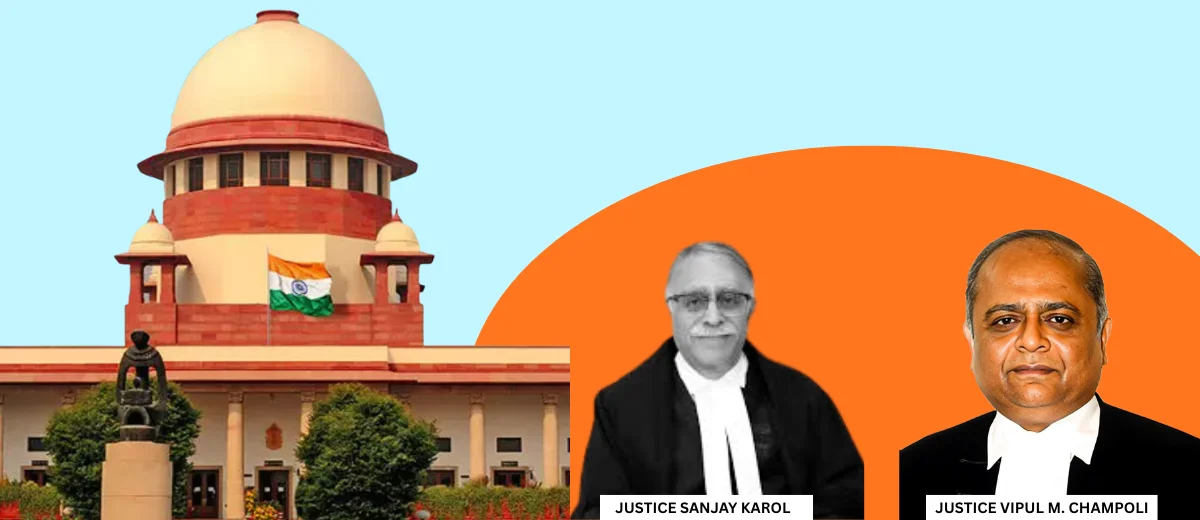
Hon’ble Judge/ Corum: Justice Sanjay Karol and Justice Vipul M. Champoli
Introduction
On March 12, 2026, Justice Sanjay Karol and Justice Vipul M Champoli held the maintainability of the writ petition filed before the Delhi High Court for the recognition of benefits denied to the
appellants, who were employees of the Air Force Group Insurance Society (AFGIS). The Supreme Court allowed the appeal for the petition by holding the AFGIS to be ‘State’ under Article 12 of the Indian Constitution.
Factual Matrix
The AFGIS was established in 1976 under the Societies Registration Act, 1860, after receiving sanctions from the Hon’ble President of India. The Board of Trustees had a special meeting dated December 27, 2016, where they resolved that the pay scales of the workers would be revised in accordance with the Sixth Pay Commission of the Government of India.
Later on February 13, 2017, by way of another meeting, it was resolved that the Societies’ pay structure would be delinked from the Central Government’s pay scale, and all the employees were asked to sign their acceptance of the revised terms via a notice circulated on May 22, 2017.
Procedural History
Aggrieved by the resolution made and the notice circulated by the Board of Trustees, a writ petition under Article 226 of the Constitution was filed before the Delhi High Court. On February 1, 2023, the learned Division Bench dismissed the petition and held it not maintainable.
It was held that the AFGIS was registered under the Societies Registration Act, 1860, in 1976 and is a self-contained, self-run welfare and insurance scheme intended exclusively for Air Force Personnel and their Families and not for the public at large.
The inclusion of Air Force Officers on the Board of Trustees does not, in itself, constitute deep or pervasive government control. This interpretation is supported by several key factors: the internal governance manages daily operations; funding is derived exclusively from member contributions and insurance premiums; and employment terms are explicitly governed by the Society’s own rules. Furthermore, the Board of Trustees retains autonomous authority over all pay structures and allowances.
Further, the Bench reaffirmed the principle tests laid down by the Constitution Bench in Ajay Hasia and Others v. Khalid Mujib Sehravardi and Others while also relying upon the Pradeep Kumar Biswas and Others v. Indian Institute of Chemical Biology and Others, wherein it was held that the cumulative facts must demonstrate financial, functional and administrative domination by the Government, with control that is deep and pervasive.
Lastly, the bench noted the clarifications made in Ex. Sub. Rajender Singh v. Union of India and Others that welfare or insurance schemes connected with the armed forces cannot automatically be treated as ‘State’ in the absence of pervasive governmental control.
Issues of the Case
The key issue observed by the Hon’ble Court was:
- Whether the Air Force Group Insurance Society (AFGIS) should be held as ‘State’ under Article 12 of the Indian Constitution?
Arguments of the Parties
Adv Shoeb Alam, learned Senior Counsel for the appellants, submitted that in official correspondence, AFGIS represented itself to be the ‘Government’. Furthermore, the organisation satisfies the cumulative tests established in Ajay Hasia (Supra) regarding state identity. Evidence of this pervasive governmental domination includes its establishment via the sanction of the Hon’ble President of India and the compulsory membership mandated for all Air Force personnel. Moreover, the Society operates on land granted by the Ministry of Defence, enjoys various tax exemptions, and performs functions of significant public and welfare importance, all while under the direct management of Senior Indian Air Force Officers (IAF).
Adv Ankur Chibber, representing AFGIS, and Additional Solicitor General Vikramjeet Banerjee, appearing for the Union of India, contended that AFGIS does not constitute ‘State’ under Article 12 of the Constitution. They argued that the organisation is a self-financed, non-public fund society with financial operations entirely independent of the Consolidated Fund of India. While IAF officers serve on deputation, their compensation is borne solely by AFGIS, and the ex officio Board of Trustees receives no additional remuneration for their roles. Furthermore, the AFGIS maintains fiscal autonomy by employing private Chartered Accountants rather than reporting to the Comptroller and Auditor General (CAG). Consequently, the counsel maintains that the High Court correctly ruled that a writ petition under Article 226 is not maintainable against the AFGIS.
Judgement Analysis
The evolution of the ‘State’ under Article 12 has shifted from a rigid, formalistic focus on statutory origins to a modern, functional, and purposive analysis. While the Court originally only recognised bodies within the traditional government structure, the expansion of state activities further necessitated for a broader examination based on the nature of functions, the degree of governmental control, and the character of activity.
Applying this modern lens to AFGIS reveals that the organisation is indeed an instrumentality of the State. Its very foundation rests on the sanction by the Hon’ble President of India, who also approved the deputation rules. This administrative control is further evidenced by the requirement for the Principal Director to provide monthly financial briefings to the Assistant Chief of Air Staff.
Furthermore, the mandatory nature of AFGIS membership and the subsequent premium deductions, which are enforced as a mandate of service by the employer, indicate a level of regulatory command that transcends a mere private association. The governance of the body is entirely comprised of serving IAF members on fixed-term deputation, meaning the administration remains in the hands of the IAF Officers despite the Society’s “private” label.
Financially, the automatic deduction of premiums from salaries charged to the Consolidated Fund of India demonstrates a pervasive control. Beyond these structural links, AFGIS performs a critical public duty by providing insurance to a specific class of public servants whose roles are indispensable to the nation’s security.
Ultimately, the Court also noted that AFGIS cannot selectively claim ‘Government’ status to secure service tax exemptions while simultaneously denying that status to evade constitutional accountability; an organisation cannot resile from its own representations to suit its legal convenience.
Conclusion
Consequently, AFGIS is held to be ‘State’ within the meaning of Article 12, rendering the writ petition maintainable before the High Court. Accordingly, the appeal was allowed.
Contributed by:- Reet Sharma (3rd Year)
GGSIPU (DME)




 > Mon - Sat, 9:00 AM – 7:30 PM