
Case Name: ASSOCIATION FOR DEMOCRATIC REFORMS AND ORS. V. ELECTION COMMISSION OF INDIA
Petition No.: W.P.(C) No. 640/2025
Neutral Citation: 2026 INSC 564
Date of Judgement: 27th May, 2026
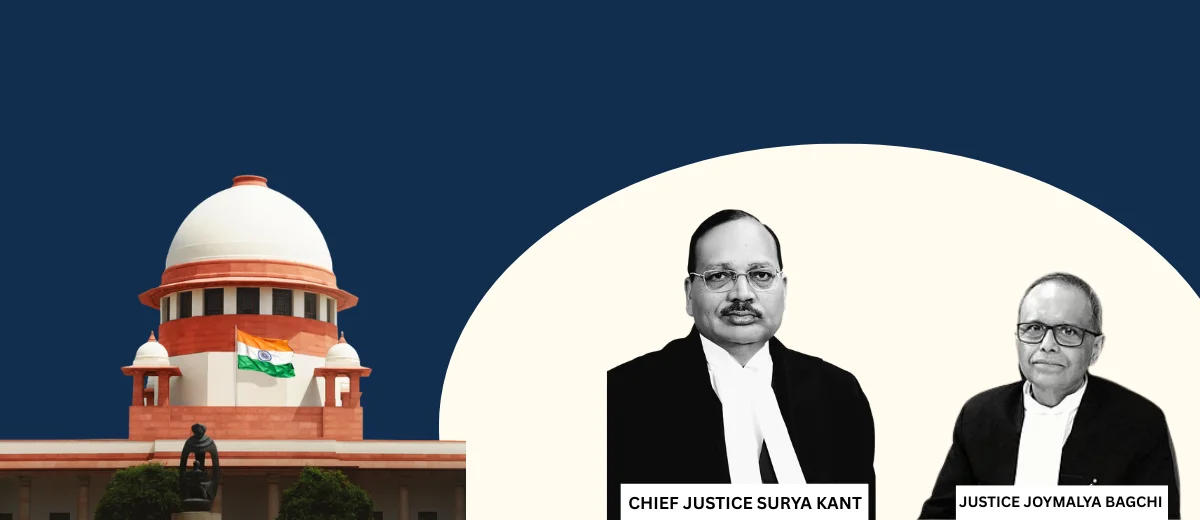
Coram: Honourable Mr Chief Justice Surya Kant & Honourable Mr Justice Joymalya Bagchi
Relevant Provisions: Articles 324, 325, 326 and 327 of the Constitution of India; Sections 15, 16 and 21 of the Representation of the People Act, 1950; Registration of Electors Rules, 1960; Citizenship Act, 1955
INTRODUCTION
This judgment, delivered by Chief Justice Surya Kant and Justice Joymalya Bagchi, is a landmark pronouncement on the scope of the powers vested in the Election Commission of India (ECI) under Article 324 of the Constitution. The Court examined the constitutional validity of the Special Intensive Revision (SIR) of electoral rolls conducted by the ECI in the State of Bihar. The central constitutional issue before the Court concerned the extent to which the ECI could examine citizenship-related questions while preparing and revising electoral rolls. The Court upheld the validity of the SIR exercise and affirmed the ECI’s authority to conduct a limited inquiry into citizenship to determine electoral eligibility. However, the Court simultaneously imposed an important constitutional limitation by clarifying that the ECI cannot adjudicate citizenship status as contemplated by the Citizenship Act.
FACTS
The ECI had issued an order directing a Special Intensive Revision of electoral rolls across Bihar under Section 21(3) of the Representation of the People Act, 1950 (RPA, 1950). The Commission justified the exercise on the basis of concerns about large-scale migration, duplication of electoral entries, rapid urbanisation, illegal cross-border migration, and inaccuracies in electoral rolls. The exercise required electors enrolled after the 2003 electoral roll revision to submit fresh enumeration forms and supporting documentation for verification of their eligibility. The Commission treated the 2003 electoral rolls as the baseline on the grounds that the 2003 revision itself was an intensive, detailed house-to-house verification.
The petitioners challenged the SIR exercise before the Supreme Court, contending that the Commission lacked authority to undertake such a large-scale scrutiny of citizenship status. The petitioners also challenged the legality of selecting 2003 as the cut-off year for verification and argued that the exercise violated Rule 21A of the Registration of Electors Rules, 1960, by permitting deletion of names without adequate procedural safeguards, including notice and hearing.
ISSUES
1. Whether the ECI possesses the power to conduct the impugned Special Intensive Revision?
2. Whether the impugned Special Intensive Revision is founded upon a legitimate purpose and whether the measures adopted are proportionate to the object sought to be achieved?
3. Whether the procedure adopted by the ECI violates the provisions of the Representation of the People Act, 1950 and the Registration of Electors Rules, 1960?
4. Whether the ECI, while exercising its constitutional mandate of preparing and maintaining electoral rolls, is empowered to scrutinise the citizenship status of persons seeking inclusion or continuation in electoral rolls?
ARGUMENTS OF THE PARTIES
The petitioners argued that Article 324 cannot be interpreted as conferring unrestricted or independent powers on the ECI once Parliament has comprehensively legislated under Article 327. It was contended that the RPA, 1950 and the Registration of Electors Rules constitute a complete statutory framework governing the revision of electoral rolls, and that the Commission could not, under Article 324, create additional procedures inconsistent with the statutory requirements. It was argued that citizenship determination falls exclusively within the domain of the Central Government under the Citizenship Act, 1955, and that the Commission had effectively assumed powers not constitutionally vested in it. The petitioners further contended that the exercise reversed the presumption in favour of existing electors and imposed an unfair evidentiary burden on persons whose names were already on the electoral rolls.
On the other hand, the ECI contended that Articles 324, 325 and 326 impose upon it a constitutional obligation to ensure free and fair elections by maintaining accurate electoral rolls. It argued that Section 16 of the RPA, 1950 disqualifies non-citizens from registration and, therefore, the Commission possesses the authority to verify citizenship status while determining electoral eligibility. The Commission further argued that Section 21(3) of the RPA, 1950, confers discretionary authority to conduct special revisions “in such manner as it may think fit”. It maintained that the impugned exercise was supported by valid reasons, including migration, duplication and concerns regarding electoral integrity.
JUDGEMENT AND ANALYSIS
The Supreme Court conducted a constitutional analysis of the nature and extent of the powers vested in the ECI under Article 324 of the Constitution. The Court framed the issue as one concerning the relationship between Articles 324 and 327 of the Constitution. The court, rejecting the petitioners’ contention, held that Articles 324 and 327 are not competing sources of power but complementary provisions of the Constitution intended to function harmoniously. Article 324 vests in the Commission the constitutional responsibility of “superintendence, direction and control” over elections and preparation of electoral rolls. Article 327, on the other hand, empowers Parliament to legislate on election-related matters but makes such legislation “subject to the provisions of this Constitution”. Thus, the Constitution envisages “mutual accommodation, and not mutual destruction”.
The Court analysed Mohinder Singh Gill v. Chief Election Commissioner (1978) 1 SCC 405, which formed the central basis of the petitioners’ challenge. The petitioners relied upon Krishna Iyer J.’s observation that Article 324 operates only in “areas left unoccupied by statute”. However, the Bench clarified that while the Commission must act in conformity with statutory law, Article 324 remains a reservoir of constitutional power enabling the Commission to ensure free and fair elections. The Court further referred to Goswami J.’s opinion, which recognised that in a vast democracy such as India, every electoral contingency cannot be anticipated by legislation. The Court synthesised the ratio of Mohinder Singh Gill into a twofold proposition. First, Article 324 confers genuine and substantive constitutional authority upon the ECI. Secondly, this authority is not absolute and cannot be exercised in violation of express statutory provisions. The Court criticised both parties for advancing partial readings of the precedent. The true constitutional principle lies in balancing both propositions together.
The judgment next discussed Kanhiya Lal Omar v. R.K. Trivedi (1985) 4 SCC 628, in which the constitutional validity of the Election Symbols Order, 1968, was upheld. The Court noted that the earlier Bench recognised the wide amplitude of the expressions “superintendence”, “direction” and “control” occurring in Article 324 and held that the Commission may issue both specific and general directions necessary for effectuating electoral purposes. Similarly, reliance was placed upon Election Commission of India v. Ashok Kumar (2000) 8 SCC 216 and Union of India v. Association for Democratic Reforms (2002) 5 SCC 294, where the Supreme Court recognised that the expression “elections” under Article 324 includes the entire electoral process and that the Commission’s powers extend to all steps necessary for ensuring free and fair elections.
After analysing several precedents, the Court formulated four constitutional propositions. First, Article 324 and Article 327 are complementary and must operate in tandem. Second, the Commission’s supervisory authority is inherently expansive, extending across all stages of the electoral process. Third, the Commission retains authority to act in areas where legislation is silent or insufficient. Fourth, while the Commission must respect statutory prohibitions, parliamentary legislation cannot be interpreted in a manner that renders Article 324 ineffective.
The Court thereafter turned to the petitioners’ reliance on A.C. Jose v. Sivan Pillai (1984) 2 SCC 656, in which the Supreme Court invalidated the introduction of voting machines by executive action because the existing statutory framework contemplated paper ballots. Distinguishing it from the present case, the Court observed that A.C. Jose applied only where the Commission’s actions directly contradicted express statutory provisions. In the present case, the statute itself, namely Section 21(3) of the RPA, 1950, expressly authorised the Commission to conduct special revisions.
The Court also interpreted Section 21(3) by examining its legislative evolution, demonstrating Parliament’s conscious intent to enlarge the Commission’s powers in relation to special revisions of electoral rolls. The non obstante clause in Section 21(3), “notwithstanding anything contained in subsection (2)”, indicated that the special revision power operates independently of the ordinary revision mechanism. The phrase “at any time” removed temporal limitations upon the Commission’s authority. The expression “for any constituency or part of a constituency” conferred territorial flexibility. Further, the words “in such manner as it may think fit” vested wide discretion in the Commission. The Court held that these expressions unmistakably reveal that Section 21(3) is an enabling provision intended to empower the Commission.
The Court then addressed whether the ECI could examine citizenship-related questions. It began by referring to Section 16 of the RPA, 1950, which disqualifies non-citizens from enrolment in electoral rolls. From this statutory requirement, the Court concluded that citizenship is a condition precedent to the right to vote and to inclusion in electoral rolls. Consequently, the Commission cannot meaningfully discharge its constitutional duty of maintaining accurate electoral rolls unless it possesses at least incidental authority to verify whether enrolled persons satisfy this threshold requirement. However, the Court held that, while the Commission may examine citizenship-related material for electoral purposes, its determination affects only the individual’s entitlement to remain enrolled as a voter and does not constitute a final declaration of citizenship status. Exclusion from an electoral roll cannot automatically result in deprivation of citizenship rights.
To institutionalise this distinction, the Court issued a procedural safeguard, directing that, wherever the Commission is not satisfied about a person’s citizenship status, the matter must be referred to the competent authority under the Citizenship Act for formal adjudication in accordance with law. The competent authority was directed to issue notice, grant an opportunity of hearing, and decide such matters preferably before the next elections. If the person is ultimately found to be a citizen, their name must be restored to the electoral roll. Additionally, the Court did not accept the petitioners’ proposition that existing enrolment in electoral rolls creates an irrebuttable presumption against further scrutiny and held that the presumption remains relevant but does not prevent the Commission from undertaking verification where circumstances justify a special revision exercise.
On the issue of procedural fairness, the Court found that the Commission had provided sufficient safeguards through notices, hearing opportunities, speaking orders and appellate remedies. It noted that detailed guidelines had been issued to Booth Level Officers and that extensive outreach measures were undertaken to facilitate participation in the revision process. The Court therefore concluded that the exercise could not be characterised as arbitrary or unconstitutional merely because it imposed additional documentary requirements.
CONCLUSION
In conclusion, the Court answered all four issues substantially in favour of the Election Commission while imposing constitutional safeguards upon the exercise of its powers. On the first issue, the Court held that the ECI possesses the constitutional and statutory authority under Article 324 and Section 21(3) of the RPA, 1950, to conduct a SIR, including prescribing modalities for such revision where circumstances require. Regarding the second issue, the Court found that the impugned SIR was founded upon legitimate objectives, such as ensuring the purity of electoral rolls, addressing duplication, migration, and the possible inclusion of ineligible persons, and further held that the measures adopted were proportionate to the object sought to be achieved.
With respect to the third issue, the Court concluded that the procedure adopted by the ECI did not violate the RPA, 1950 or the Registration of Electors Rules, 1960, since adequate safeguards, including notices, hearing opportunities, speaking orders and appellate remedies, had been provided and the exercise was authorised under the broad framework of Section 21(3). For the fourth issue, the Court held that the ECI is empowered to undertake a limited inquiry into citizenship status to determine electoral eligibility, as citizenship is a condition precedent to inclusion in the electoral rolls under Section 16 of the RPA, 1950. However, such scrutiny remains confined strictly to electoral purposes and cannot amount to a final or conclusive adjudication of citizenship under the Citizenship Act, 1955, which continues to remain within the jurisdiction of the competent statutory authority.
The court ultimately upheld the validity of the Special Intensive Revision conducted in Bihar while simultaneously limiting the scope of the Commission’s authority in matters of citizenship determination. By harmonising Articles 324 and 327 and by carefully balancing electoral integrity with procedural fairness and citizenship protections, the judgment strengthens the constitutional framework governing free and fair elections in India.



 > Mon - Sat, 9:00 AM – 7:30 PM