
Case Name: SANJAY DAVE Vs. ANDHRA BANK LTD. & ORS.
Petition No.: CIVIL APPEAL NOS.12264-12266 OF 2024
Neutral Citation: 2026 INSC 580
Date of Judgement: 27th May, 2026
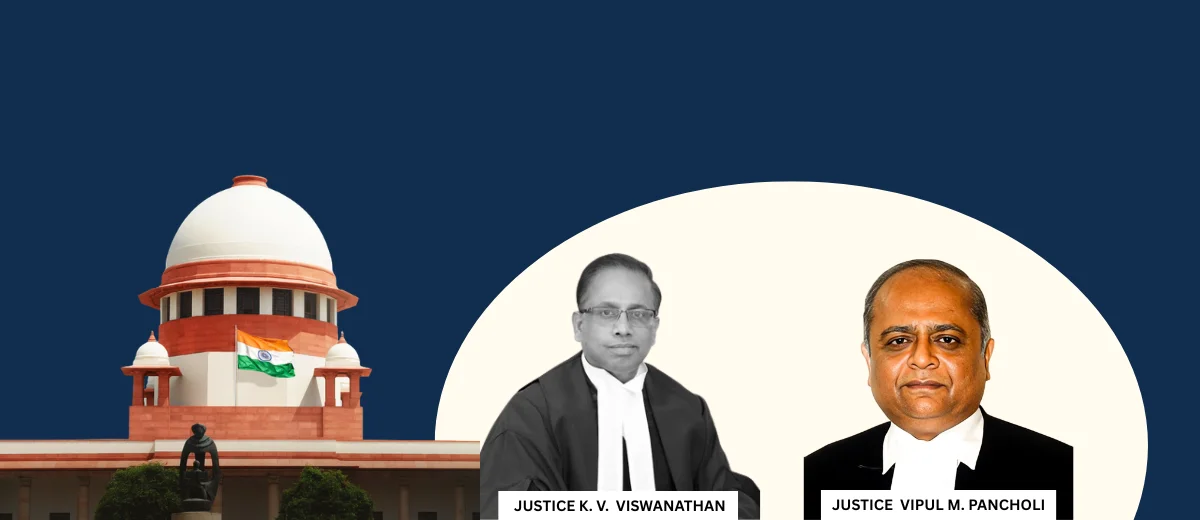
Coram: Honourable Mr Justice K. V. Viswanathan & Honourable Mr Justice Vipul M. Pancholi
Relevant Provisions: Sections 30, 31, 33 and 62 of the Insolvency and Bankruptcy Code, 2016
INTRODUCTION
In this case, the Supreme Court reaffirmed the binding and irrevocable character of a resolution plan once approved by the Committee of Creditors (CoC) under the Insolvency and Bankruptcy Code, 2016 (IBC). The Court held that a Successful Resolution Applicant cannot indirectly withdraw from a CoC-approved resolution plan by subsequently objecting to terms and conditions that were already discussed, accepted, and incorporated during the insolvency resolution process. The Court emphasised that the IBC is founded upon strict timelines, certainty, and the primacy of the commercial wisdom of the CoC. Any attempt by a Successful Resolution Applicant to delay or frustrate implementation of an approved resolution plan through artificial objections would undermine the architecture and objectives of the Code.
FACTS
The present appeals arose out of the Corporate Insolvency Resolution Process (CIRP) initiated against M/s Oracle Home Textiles Limited. The CIRP was admitted and a Resolution Professional was appointed. Subsequently, a Request for Resolution Plan was issued. The appellant was a promoter and director of the Corporate Debtor. Since the Corporate Debtor held MSME status, the National Company Law Tribunal (NCLT) permitted the appellant to submit a resolution plan. The appellant accordingly submitted a plan, which was approved by the CoC with an overwhelming 99.90% vote.
At the relevant time, certain prospective resolution applicants had pending applications before the NCLT seeking permission to submit resolution plans. These proceedings were known to all stakeholders, including the appellant. The Resolution Professional issued a Letter of Intent (LoI) in favour of the appellant. The appellant objected to the LoI on the ground that it was “conditional”. The objection related to a stipulation that the approval of the resolution plan would remain subject to the orders reserved by the NCLT in pending proceedings initiated by prospective resolution applicants. The appellant further objected to another stipulation under which any litigation risk arising from claims by workers, staff, or employees would be borne by the Successful Resolution Applicant.
Since the appellant declined the first LoI, a second LoI was issued. Upon continued non-acceptance, a third LoI was issued, additionally requiring submission of an unconditional performance guarantee within seven days in accordance with the Request for Resolution Plan. The appellant still failed to accept the LoI or furnish the performance guarantee. Consequently, the Resolution Professional forfeited the Earnest Money Deposit of Rs. 1 crore under the terms of the Request for Resolution Plan. The appellant thereafter filed applications before the NCLT seeking reissuance of an unconditional LoI and restoration of the forfeited Earnest Money Deposit.
Meanwhile, the CIRP period expired. Since no valid resolution plan survived implementation, the CoC, with 99.61% voting share, resolved to liquidate the Corporate Debtor under Section 33(2) of the IBC. The NCLT dismissed the appellant’s applications and allowed liquidation. The NCLAT affirmed the decision. Aggrieved thereby, the appellant approached the Supreme Court under Section 62 of the IBC.
ISSUES
1. Whether the LoIs issued by the Resolution Professional were conditional in nature and contrary to the approved resolution plan?
2. Whether the forfeiture of the Earnest Money Deposit was lawful?
3. Whether the liquidation of the Corporate Debtor under Section 33 of the IBC was valid?
ARGUMENTS OF THE PARTIES
The appellant contended that the LoIs issued by the Resolution Professional were conditional and therefore inconsistent with both the IBC and the approved resolution plan. According to the appellant, the stipulation making the approval of the resolution plan subject to the outcome of pending proceedings before the NCLT fundamentally altered the nature of the LoI and imposed an impermissible contingency. The appellant also challenged the stipulation regarding liabilities arising from litigation initiated by workers and employees, arguing that such liabilities could not be imposed on the Successful Resolution Applicant after approval of the plan.
The respondents, including the lead bank and the Liquidator, opposed the appeal. They argued that the appellant was fully aware of the pending proceedings involving prospective resolution applicants, as such matters had repeatedly been discussed at CoC meetings attended by the appellant himself. The respondents further contended that the appellant had expressly agreed to the conditions later objected to and that the challenge to the so-called conditional LoI was merely an afterthought intended to delay implementation of the approved plan. It was also argued that the forfeiture of the Earnest Money Deposit strictly complied with Clause 1.9.4 of the Request for Resolution Plan, since the appellant had failed to furnish the performance guarantee and had failed to comply with the terms of the approved plan. With respect to liquidation, the respondents submitted that Section 33 of the IBC expressly empowers the CoC to resolve for liquidation at any time prior to confirmation of the resolution plan by the adjudicating authority and that such commercial decisions are ordinarily beyond judicial review.
JUDGEMENT AND ANALYSIS
The judgment authored by Justice K.V. Viswanathan constitutes an important reaffirmation of the binding character of CoC-approved resolution plans and the limited role of judicial intervention under the IBC.
Addressing the first issue, the Court rejected the appellant’s contention that the LoIs were conditional in nature. It was observed that the stipulation that made the LoI subject to the outcome of pending proceedings before the NCLT did not constitute an impermissible condition. Rather, it merely acknowledged that judicial decisions would prevail and bind the parties. The Court held that even in the absence of such a stipulation, the eventual adjudicatory outcome would necessarily govern the parties. The Court placed considerable reliance upon the minutes of various CoC meetings to establish that the appellant had full knowledge of the pending proceedings and the relevant stipulations. The appellant actively participated in discussions in which these issues were deliberated. Consequently, the Court held that the appellant could not later feign ignorance or characterise the conditions as unexpected.
With respect to the second issue, the Court, rejecting the challenge relating to liabilities arising from employee and worker litigation, noted that the appellant had expressly agreed during CoC meetings that such risks would be borne by the Successful Resolution Applicant. The Court therefore held that the appellant could not subsequently approbate and reprobate by accepting the benefits of the process while repudiating the obligations flowing from it.
In elaborating this principle, the Court relied on Chairman, State Bank of India v. M.J. James (2022) 2 SCC 301, in which the doctrine of acquiescence was explained as a form of tacit consent arising from conduct. The Court extracted the principle that a party who knowingly permits another to proceed in a manner inconsistent with an existing right cannot later challenge that conduct after having silently accepted it. This principle was further reinforced through reliance on Rajasthan State Industrial Development & Investment Corporation Ltd. v. Diamond & Gem Development Corporation Ltd. (2013) 5 SCC 470, where the Court had held that a party cannot “blow hot and cold” by selectively accepting advantageous aspects of a transaction while repudiating burdensome ones.
A substantial part of the judgment focused on the binding nature of the CoC-approved resolution plans. The Court relied extensively upon the decision in Ebix Singapore Pvt. Ltd. v. Committee of Creditors of Educomp Solutions Ltd. (2022) 2 SCC 401, wherein, the Supreme Court had categorically held that once a resolution plan is approved by the CoC and submitted to the adjudicating authority, there exists no statutory scope for withdrawal or modification of the plan at the behest of the Successful Resolution Applicant.
The Court in the present case emphasised that the only remaining contingency after CoC’s approval is the approval of the adjudicating authority under Section 31, whose jurisdiction is limited to examining compliance with Section 30(2) of the IBC. The adjudicating authority cannot compel renegotiation or entertain attempts by the Successful Resolution Applicant to evade obligations arising under its own plan. The Supreme Court strongly deprecated the appellant’s conduct and observed that the objections regarding conditionality were merely a “subterfuge” and a “clever ploy” to indirectly withdraw from the resolution process. The Court warned that permitting such tactics would undermine the certainty and efficiency that the IBC seeks to achieve.
On the issue of performance guarantee, the Court held that although forty-five days had initially been granted due to the extraordinary circumstances of the pandemic, the appellant had failed to act even within that period. Further, the Court noted that during subsequent CoC meetings, the appellant had expressly agreed to furnish the guarantee within seven days as required under the Request for Resolution Plan. The Court therefore rejected the argument that the revised timeline violated the CoC’s earlier decision.
Regarding forfeiture of the Earnest Money Deposit, the Court examined Clause 1.9.4 of the Request for Resolution Plan, which specifically authorised forfeiture where the Successful Resolution Applicant failed to submit the performance guarantee or otherwise failed to comply with the plan process. Since the appellant had admittedly failed to accept the LoI and furnish the guarantee, the Court held that forfeiture was entirely lawful. The Court upheld the validity of liquidation under Section 33 of the IBC.
Regarding the aspect of liquidation, referring to Manish Kumar v. Union of India (2021) 5 SCC 1, the Court reiterated that where the CoC, by the requisite voting majority, decides to liquidate the Corporate Debtor before confirmation of the resolution plan, the adjudicating authority is bound to pass a liquidation order. The Court further emphasised the paramountcy of the CoC’s commercial wisdom, citing K. Sashidhar v. Indian Overseas Bank (2019) 12 SCC 150. In that case, the Supreme Court held that the commercial decision of the CoC is non-justiciable and that adjudicatory authorities are not empowered to examine the correctness or fairness of such decisions.
Applying these principles, the Court concluded that the CoC had legitimately exercised its commercial wisdom in deciding to reject the appellant’s plan and proceed towards liquidation after the appellant’s own conduct frustrated implementation of the approved resolution process. The Court ultimately held that there was no illegality in either the forfeiture of the Earnest Money Deposit or the liquidation of the Corporate Debtor. All interim orders were vacated, and the Liquidator was directed to proceed with the liquidation process in accordance with the law.
CONCLUSION
The judgment in Sanjay Dave v. Andhra Bank Ltd. & Ors. made it unequivocally clear that once a resolution plan receives approval from the CoC, the Successful Resolution Applicant cannot seek to reopen negotiations or indirectly withdraw from the plan through technical objections. The decision reinforces the finality of CoC-approved plans, the sanctity of commercial wisdom, and the importance of strict adherence to timelines within the insolvency framework. The Court’s reliance upon doctrines such as acquiescence and approbate and reprobate further demonstrates that parties participating in insolvency proceedings are bound by their conduct and representations throughout the process.


 > Mon - Sat, 9:00 AM – 7:30 PM