
Case Name: KUMUD LALL V. SURESH CHANDRA ROY
Petition No.: Special Leave Petition (Civil) Nos. 33646 – 33647 of 2018
Neutral Citation: 2026 INSC 443
Date of Judgement: 4th May, 2026
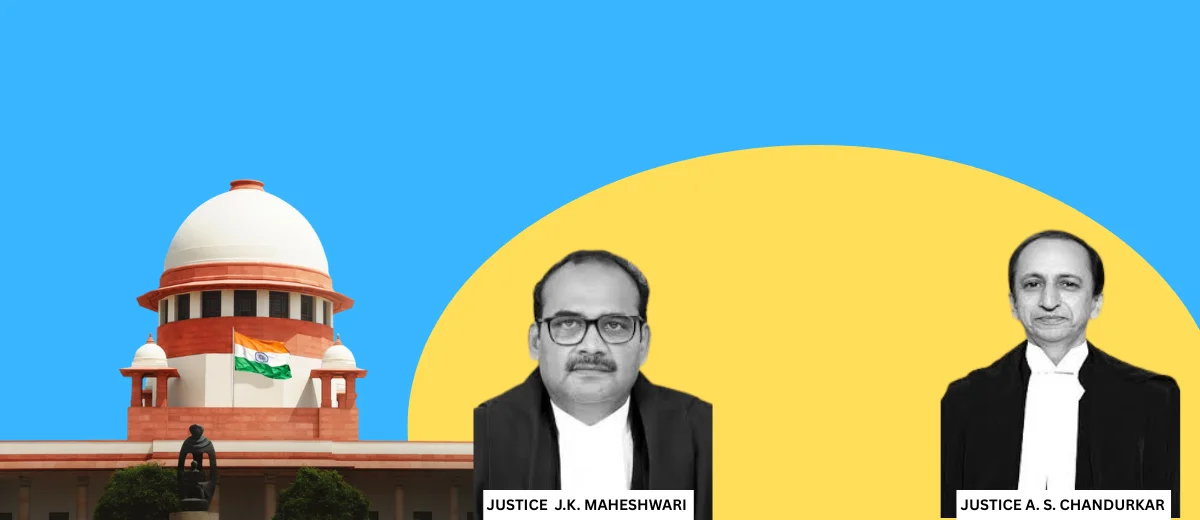
Coram: Honourable Mr Justice JK Maheshwari and Honourable Justice Atul S Chandurkar
Relevant Provisions: Order XXII of the Civil Procedure Code, Section 306 of the Indian Succession Act, 1925
INTRODUCTION
This case lies at the intersection of tort law, the Consumer Protection Act, and the law relating to succession. It discusses the survivability of medical negligence claims upon the death of the alleged tortfeasor. The Court clarified that proceedings under the Consumer Protection Act do not automatically abate upon a doctor’s death and can continue against the doctor’s legal representatives. However, this liability is not personal but is confined to the estate they inherited. The judgment involves a harmonious construction of procedural law under Order XXII of the CPC, in conjunction with the principles under Section 306 of the Indian Succession Act, 1925.
FACTS
The dispute originated from a consumer complaint filed before the District Consumer Forum, Munger, alleging medical negligence by Dr P.B. Lall in the treatment of the complainant’s wife, which allegedly resulted in loss of vision. The District Forum partly allowed the complaint and awarded compensation. However, on appeal, the State Consumer Disputes Redressal Commission reversed the finding, holding that negligence was not established due to a lack of expert evidence.
Aggrieved, the complainant filed a revision petition before the National Consumer Disputes Redressal Commission (NCDRC). During the pendency of this revision, Dr Lall passed away. An application was moved to substitute his legal heirs, his wife and son. The NCDRC allowed the substitution and held that the proceedings could continue, with any liability recoverable from the deceased’s estate.
The legal heirs challenged this order before the Supreme Court, contending that, as the cause of action was personal in nature, the proceedings abated upon the doctor’s death and that no liability could be imposed upon them.
ISSUE
Whether, upon the death of the doctor during the pendency of proceedings at the appellate stage, the legal heirs can be impleaded and held liable for the alleged act of medical negligence of the deceased doctor? If yes, to what extent?
ARGUMENTS OF THE PARTIES
The appellants (legal heirs) argued that medical negligence constitutes a personal cause of action, which does not survive the death of the alleged wrongdoer, invoking the maxim actio personalis moritur cum persona. They further contended that since the doctor had succeeded before the State Commission and no decree existed at the time of his death, no enforceable liability survived. Reliance was placed on judicial precedents and Section 306 of the Indian Succession Act to argue that such claims abate.
The respondents (complainants) countered that the Consumer Protection Act incorporates the procedural provisions of Order XXII CPC, which explicitly allow substitution of legal representatives where the “right to sue survives”. They argued that claims for pecuniary loss and compensation are recoverable from the estate of the deceased, and that legal representatives merely step into the shoes of the deceased to the extent of the estate.
JUDICIAL REASONING
The Supreme Court approached the controversy by carefully examining both the procedural and substantive questions of substitution and survivability of the cause of action. At the outset, the Court clarified that the mere applicability of Order XXII of the Code of Civil Procedure, 1908, by virtue of Section 13(7) of the Consumer Protection Act, 1986, does not automatically resolve whether proceedings can continue after the death of a party. Order XXII is purely procedural; it facilitates substitution of legal representatives only where the “right to sue survives”. Consequently, the determinative inquiry lies in substantive law, particularly Section 306 of the Indian Succession Act, 1925, which governs the transmission of rights and liabilities upon death.
A central aspect of the Court’s reasoning was its interpretation of the exception carved out under Section 306, namely, “causes of action for personal injuries not causing the death of the party”. The Court rejected an overly broad construction of this exception. It held that not all claims arising from personal injury are extinguished; rather, the decisive factor is whether the claim is purely personal in nature or whether it has a demonstrable impact on the estate. Where the injury translates into quantifiable pecuniary loss, such as medical expenses, loss of income, or other economic damages, it ceases to be purely personal and assumes the character of a transmissible claim. In such circumstances, the cause of action survives and can be enforced against the estate of the deceased through legal representatives.
Then, reading this substantive position in the light of the procedural framework under Order XXII CPC, it explained that upon the death of a sole defendant, if the right to sue survives, the legal representatives must be brought on record; failing which, the proceedings abate. However, such a substitution does not create a new liability; rather, the legal representatives merely step into the deceased’s shoes, limited to his estate. Any liability that may be determined is enforceable only against the estate, not against the personal assets of the legal heirs.
The ‘right to sue’ means the right to seek relief through legal proceedings. Such proceedings are instituted against the opposite party/defendant(s), who possess a corresponding right to defend, as opposed to the claimant’s right to prosecute. The right to defend is intrinsically linked to and arises from the right to prosecute, and vice versa. Therefore, for the continuation of proceedings, it is essential that both rights co-exist.
In addressing the argument that no decree existed against the doctor at the time of his death, the Court clarified that survivability of a cause of action is not contingent upon the existence of a crystallised decree. The relevant inquiry is whether a subsisting “right to sue” existed on the date of death. Finally, the bench summarised the following principles regarding the survival of the “right to sue” legal representatives of the deceased litigant (Para 64):
- The common law maxim ‘actio personalis moritur cum persona’ in India has been statutorily modified by various statutory instruments such as the Fatal Accidents’ Act of 1855, the Legal Representatives’ Suits Act of 1855, the Indian Succession Act of 1925, etc.;
- That the legal representative of the deceased can institute a fresh suit or be sued afresh in terms of the Legal Representatives Suits Act, 1855 or in terms of Section 306 of the Indian Succession Act, 1925;
- Continuation of suit by or against the legal representative of the deceased has to be in terms of Section 306 of the Indian Succession Act, 1925 (substantive law);
- Procedural prescription under Order XXII of CPC, concerning substitution of legal representative of the deceased party, should be harmoniously construed with Section 306 of the Indian Succession Act.
- The continuation of ‘right to sue’ under Order XXII Rule 2, read with Rule 4, is to be seen on the date of death.
- Generally, all rights and liabilities to maintain a suit are carried to the legal representative under Section 306 of the Indian Succession Act, 1925. However, when adjudicating claims under 1st exception to Section 306 of the Indian Succession Act, 1925, personal injury claims abate, while claims for or against the estate of the deceased survive.
CONCLUSION
The Supreme Court upheld the NCDRC’s decision allowing substitution of legal heirs but clarified the scope of their liability. It held that medical negligence claims under the Consumer Protection Act can survive the death of the doctor and continue against his/her legal representatives, provided the cause of action pertains to recoverable claims.
Therefore, the Court laid down that the adjudicatory forum must undertake a two-stage analysis: first, determine whether medical negligence is established on the merits; and second, identify which components of the claim survive against the estate under Section 306. Only those claims that are legally transmissible can be enforced, while purely personal claims are extinguished upon the death of the wrongdoer.


 > Mon - Sat, 9:00 AM – 7:30 PM