
Case Name: BHAGAT SINGH V. THE STATE OF UTTAR PRADESH AND ANOTHER
Petition Number: SLP(CRL) NO. 4240 OF 2026
Neutral Citation: 2026 INSC 527
Date of Judgment: 22.05.2026
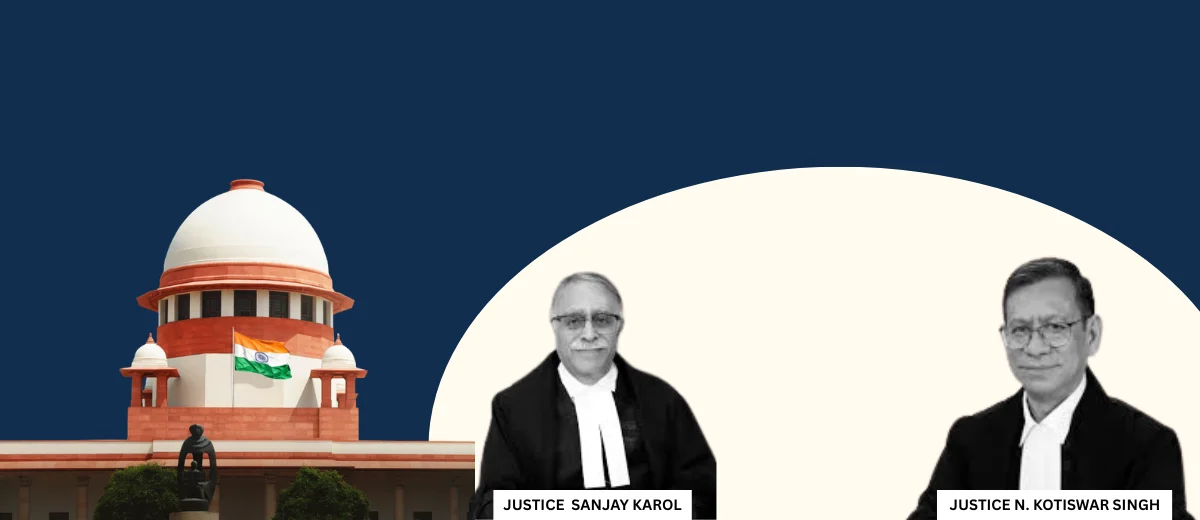
Coram: HON’BLE JUSTICE MR. SANJAY KAROL & HON’BLE MR. JUSTICE NONGMEIKAPAM KOTISWAR SINGH
Relevant Provisions: Section 174 of the Criminal Procedure Code, Section 194 of the Bhartiya Nagrik Suraksha Sanhita, Section 103(1) of the Bharatiya Nyaya Sanhita, 2023, Section 352 of the Bharatiya Nyaya Sanhita, 2023, Section 351(2) of the Bharatiya Nyaya Sanhita, Section 3(5)of the Bharatiya Nyaya Sanhita, 2023, Section 5 of the Arms Act, 1959, Section 25 of the Arms Act, 1959 and Section 27 of the Arms Act, 1959.
INTRODUCTION
The primary question before the Supreme Court was whether non-mention of an accused in an inquest report could, by itself, indicate innocence or justify grant of bail despite other incriminating material collected during investigation. The Court examined the limited scope of inquest proceedings under Section 174 of the Code of Criminal Procedure [CrPC] /Section 194 of the Bharatiya Nagrik Suraksha Sanhita [BNSS] and ultimately held that omission of the accused’s name in the inquest report cannot override substantive evidence such as the FIR, witness statements, medical evidence, and weapon recovery to form the sole basis of decision on bail matters.
FACTS
The appeal arose from an order passed by the High Court of Judicature at Allahabad granting bail to Respondent No. 2, who was accused of murdering the appellant’s uncle. The prosecution alleged that the respondent along with two co-accused intercepted the deceased while he was proceeding towards his agricultural field and fatally shot him with country-made pistols. An FIR was registered under Sections 103(1), 352, 351(2), and 3(5) of the Bharatiya Nyaya Sanhita, 2023 [BNS] along with relevant provisions of the Arms Act, 1959. During investigation, a .315 bore country-made pistol and an empty cartridge were recovered at the instance of the respondent pursuant to his disclosure statement. The Sessions Judge, Mathura, rejected the respondent’s bail application considering the gravity of the offence, the post-mortem report, and the recovery of the weapon. However, the High Court granted bail primarily on the ground that the informant and another witness had not named the respondent during the inquest proceedings. The appellant by the way of the present appeal challenged this order before the Supreme Court contending that the High Court had passed a cryptic and unreasonable order without properly appreciating the material evidence and circumstances of the case.
ISSUE
Whether non-mention of the accused in the inquest report can, by itself, be treated as a circumstance suggesting innocence or justify the grant of bail despite other incriminating material on record?
JUDGMENT AND ANALYSIS
The Supreme Court observed that Respondent No. 2 had been specifically named in the FIR with a direct allegation of firing upon the deceased. The prosecution case was further corroborated by the post-mortem report, which recorded ante-mortem firearm injuries, including entry and exit wounds with blackening and tattooing, and opined that death occurred due to shock and haemorrhage caused by firearm injuries. During investigation, a .315 bore country-made pistol along with a spent cartridge was also recovered at the instance of the respondent pursuant to his disclosure statement. Statements recorded under Section 180 of the BNSS, including those of the informant, the deceased’s wife, brother, and another witness, prima facie supported the allegations against the respondent.
The Court held that the High Court had erred in granting bail solely on the basis that the informant and another Panch witness had not named the respondent during the inquest proceedings. The court referred to Section 174 CrPC (now Section 194 BNSS) and relied upon decisions made on the pari materia section in Pedda Narayana v. State of A.P [(1975) 4 SCC 153] and Amar Singh v. Balwinder Singh [(2003) 2 SCC 518] to reiterate that the purpose of an inquest is limited to ascertaining the apparent cause of death and not to record details of the occurrence or identify the accused. Therefore, non-mentioning of the accused during inquest proceedings could not by itself discredit the prosecution case.
The Court concluded that the High Court ignored material evidence and failed to apply settled principles governing bail in serious offences. Consequently, the impugned bail order was set aside, the matter was remanded to the High Court for fresh consideration, and Respondent No. 2 was directed to surrender within one week and remain in judicial custody pending reconsideration of bail.
CONCLUSION
The court held that an inquest report is confined to determining the apparent cause of death and is not intended to identify offenders or narrate the entire incident. The Supreme Court clarified that courts must evaluate bail applications by considering the totality of the material collected during investigation rather than isolated omissions in preliminary proceedings. Holding that the High Court ignored significant incriminating evidence, the Court set aside the bail order and remanded the matter for fresh consideration in accordance with law.




 > Mon - Sat, 9:00 AM – 7:30 PM