
Case Name: JENNIFER MESSIAS V. LEONARD G LOBO
Petition Number: Civil Appeal 2026 @ SLP(C) Nos. 8716-8717 OF 2026
Neutral Citation: 2026 INSC 502
Date of Judgment: 18.05.26
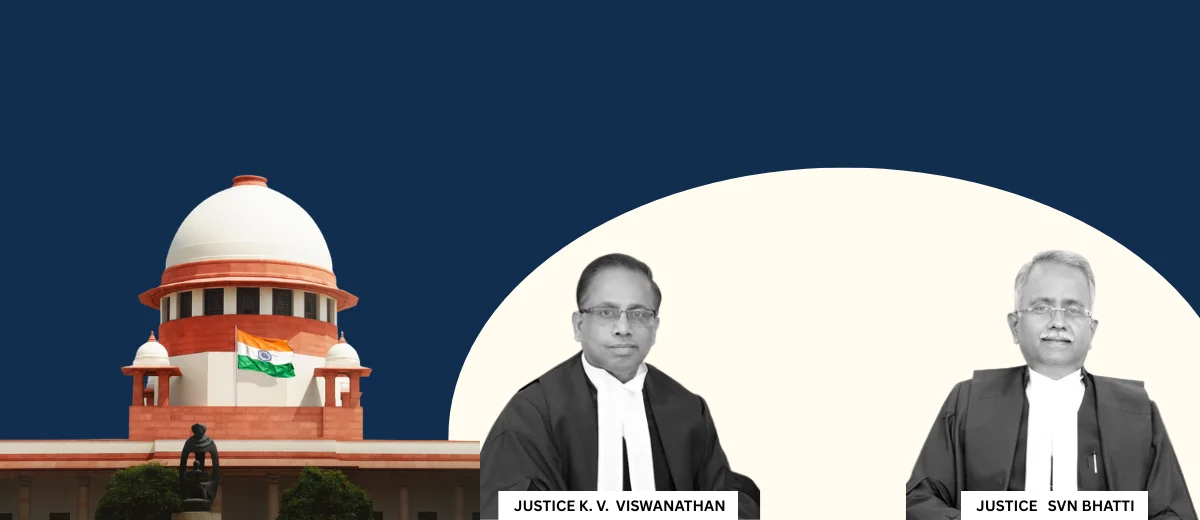
Coram: HON’BLE JUSTICE K.V. VISWANATHAN & HON’BLE JUSTICE S.V.N. BHATTI
INTRODUCTION
This case is an important reminder of the procedural difficulties that litigants in India often continue to face even after winning a decree. The concerned dispute in this case was whether a decree passed in a partition suit, though formally called a “preliminary decree”, could be directly executed when actual physical division of the property was practically impossible. Through its ruling, the Supreme Court clarified the law relating to composite decrees and stressed that substantive justice should prevail over procedural formalities, especially to ensure that litigants are not forced into endless legal proceedings even after securing relief.
FACTS AND PROCEDURAL HISTORY
Jennifer and Peter Messias, a married couple, had purchased a residential flat in Jabalpur from their combined income. After their judicial separation, Jennifer filed a suit for partition and separate possession and on 13 April 2012 the trial court passed a decree declaring her one-half share and awarding mesne profits of Rs. 1,500 per month. The decree also appointed a commissioner and provided that if partition by metes and bounds was not possible, the property could be sold and the proceeds divided.
An initial execution attempt was dismissed, after which Jennifer pursued proceedings under Order XX Rule 18 CPC. Peter died in 2014 and Leonard G. Lobo was brought on record as legal representative. A commissioner later reported that the flat could not be partitioned by metes and bounds, leading the executing court to direct auction and division of sale proceeds. The High Court twice intervened, first saying a final decree was necessary and later restraining execution again, which led to present appeals.
ISSUE
Whether the Decree dated 13.04.2012 is a simple Preliminary Decree, or whether the Trial Court, in its wisdom, has made it both a Preliminary and a Final Decree.
SUBMISSIONS OF THE PARTIES
The Appellant argued that the earlier orders incorrectly treated the decree dated 13.04.2012 as merely a Preliminary Decree. It was submitted that, after the Court Commissioner’s Report, which clearly stated that the property could not be divided by metes and bounds, the only practical solution was sale of the property through public auction, which had already been directed by the Executing Court and acted upon by both parties through bids and counter-bids. They also argued that once physical partition became impossible, the decree effectively attained finality and directing the parties to again seek a Final Decree under Order XX Rule 18 CPC was only a technical and unnecessary exercise with no practical purpose.
The Respondent submitted that the decree dated 13.04.2012 was purely a preliminary decree and therefore could not be executed in law. It was contended that a Preliminary Decree only determines the rights and shares of the parties, whereas execution can proceed only after a Final Decree is passed. They claimed that the High Court rightly held that execution proceedings were not maintainable in the absence of a Final Decree and acted within its jurisdiction in directing the parties to first obtain such a decree. It was further submitted that the previous orders had already attained finality and that the Appellant was not entitled to mesne profits since the delay in the proceedings was attributable to the appellant.
JUDGEMENT AND ANALYSIS
While determining the issue, the Supreme Court first referred to Section 2(2) of the CPC, which defines a decree and clarifies that a decree may be preliminary, final or partly preliminary and partly partial. It also considered Order XX Rule 12 CPC relating to mesne profits and Order XX Rule 18 CPC relating to partition suits. The Court emphasized that the procedure under these provisions had substantially already been followed in the present case.
While discussing the precedents, the Court relied upon Shankar Balwant Lokhande v. Chandrakant Shankar Lokhande (1995) 3 SCC 413 and observed that a preliminary decree determines the rights of parties, whereas the final decree gives effect to those rights. However, where physical partition is not possible, sale and distribution of proceeds may become the only practical solution. From Bimal Kumar v. Shakuntala Debi (2012) 3 SCC 548, the Court drew the critical legal proposition – “It is well settled in law that a preliminary decree declares the rights and liabilities, but in a given case, a decree may be both preliminary and final…what is executable is a final decree and not a preliminary decree unless and until the final decree is a part of the preliminary decree.”, where it clarified that if a Preliminary Decree itself contains the elements of a Final Decree, then it can still be executed. Therefore, the real issue in the present case was not the label given to the decree dated 13.04.2012, but whether the decree had already finally determined the rights and remedies of the parties.
The Supreme Court then closely examined the Decree and found that it did much more than merely declare shares of the parties. The decree recognized the half share of both parties, granted possession rights, awarded mesne profits to Jennifer Messias and also appointed an Advocate Commissioner to examine whether the property could be partitioned by metes and bounds. Importantly, the decree itself provided that if partition was not possible, compensation and further steps could be worked out. Later , the Advocate Commissioner’s Report clearly stated that the property could not be physically partitioned. Therefore, the Executing Court rightly proceeded towards auction of the property.
The Court held that the High Court committed an error by focusing only on the label of the decree as a “Preliminary Decree” without examining its actual contents and legal effect. The Court further noted that once the Commissioner had already reported that partition by metes and bounds was impossible, directing the Appellant to again seek a final decree was unnecessary and merely an academic exercise. In substance, the decree had already attained finality regarding the rights of the parties and the mechanism for sale and distribution.
CONCLUSION
The Supreme Court set aside the previous orders of the High Court and restored the execution proceedings. The executing court was directed to proceed with auction of the property through the Advocate Commissioner and to first adjust the mesne profits payable to Jennifer Messaias before distributing the remaining sale proceeds. Considering the prolonged litigation and age of Jennifer Messias, the Court directed the Trial Court to complete the proceedings within two months.






 > Mon - Sat, 9:00 AM – 7:30 PM