Case Name: RAM CHANDRA CHOUDHARY & ORS V. ROOP NAGAR DUGDH UTPADAK SAHAKARI SAMITI LIMITED AND OTHERS
Petition Number: CIVIL APPEAL ARISING OUT OF SLP (C) NO. 38579 OF 2025
Neutral Citation: 2026 INSC 347
Date of Judgement: 10.04.2026
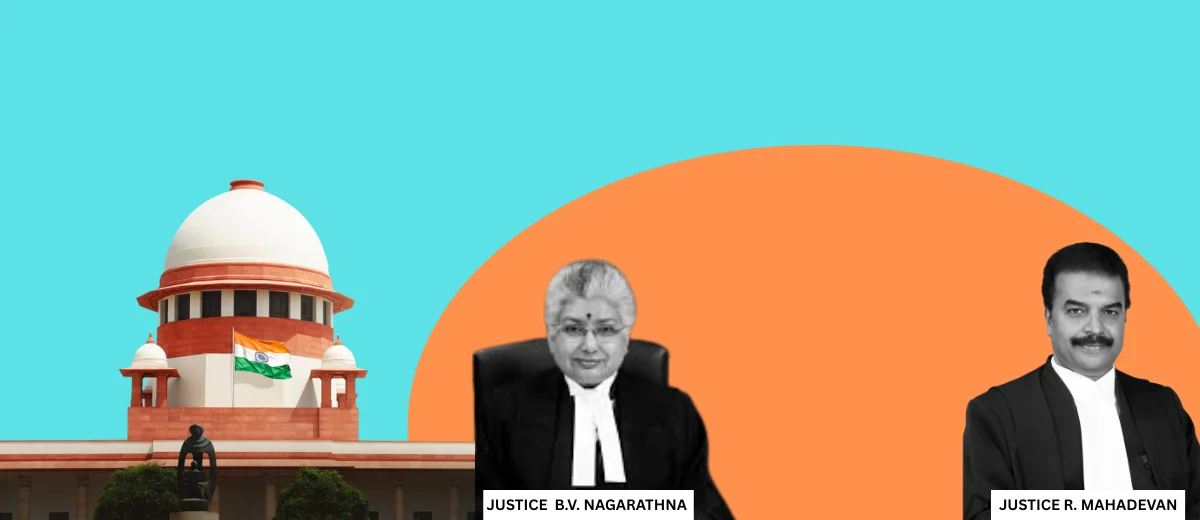
Coram: HON’BLE MS. JUSTICE B.V. NAGARATHNA AND HON’BLE MR. JUSTICE R. MAHADEVAN
INTRODUCTION
The above case is an important comprehensive judgment of the Hon’ble Supreme Court with regard to the distinction between the Right to Vote and the Right to Contest in Elections. The Supreme Court also examined whether the bye-laws of the Rajasthan Co-operative Societies Act, 2001 were ultra vires the Act and shed light on the reasonable opportunity of hearing, what all institutions qualify as ‘State’, the extent of ‘Non-State’ entities within the ambit of Article 12, and the principle of Locus Standi in this case.
FACTS AND PROCEDURAL HISTORY
The appellants were Chairpersons of District Milk Producers’ Cooperative Unions under the Rajasthan Co-operative Societies Act, 2001 (hereinafter referred to as the said Act). Bye-laws were enacted under the said Act to govern the functioning of Co-operative Societies, which introduced new eligibility conditions for candidates contesting in elections to the Management Committee of the Co-operative Societies. These laws were challenged vide Writ Petitions before the High Court, wherein a Single Judge allowed the appeal, pronouncing the laws as ultra-vires and the same was affirmed by a Division Bench upon appeal by the State. It is pertinent to note that the Appellants in the present case were not impleaded as parties to the said Writ Petitions. The Registrar, vide notice, directed amendment of the said bye-laws and by further notice, to finalize the amendments if there are no objections. Hence, the Appellants who were not parties to the original Writ proceedings, preferred the present appeal before the Supreme Court, contending that they were affected by the impugned judgement of the Division Bench.
ISSUES
- Whether the Writ Petition filed under Article 226 before the High Court was maintainable?
- Whether the Appellants, who were not parties to the original writ proceedings, have Locus Standi to maintain the appeal before the Supreme Court?
- Whether the impugned bye-laws were Ultra Vires of their parent Act?
SUBMISSIONS OF THE PARTIES
The Counsel for the Appellants submitted that the Writ Petition filed before the High Court was not maintainable as they do not qualify as “State” or “Instruments or Agencies of the State” within Article 12 of the Constitution of India. It was further submitted that mere statutory control does not mean, it is amenable under Writ Jurisdiction, unless an express statutory provision has been violated. Moreover, the Counsel contended that the remedies in the Act have not exhausted to invoke Article 226 and that the High Court committed an error by striking down the judgement without checking if all necessary parties are impleaded in the proceeding and thus, a reasonable opportunity to be heard was not afforded to the Appellants.
The Counsel for the Respondents contended that Sections 10 and 11 recognise the authority allowing amendment of bye-laws and that Section 32 provides for the elections to be conducted according to the Act as well as the byelaws. It was further contended that the bye-laws do not constitute disqualifications but only prescribe eligibility conditions for participating in elections, relying on Sections 16, 18, 19 and 20 which state that the rights related to voting, membership and participation must comply with the conditions stipulated in the bye-laws. Moreover, it was added that Section 117 bars jurisdiction of courts in amendments related to bye-laws and that Sections 58 and 60 vest exclusive jurisdiction with the Registrar in disputes related to elections and management of cooperative societies.
JUDGEMENT AND ANALYSIS
Locus Standi of the Parties
The judgement commenced with the Supreme Court addressing the objection regarding the Locus Standi of the Appellants. The Court, referring to Ram Janam Singh v. State of U.P. (1994) 2 SCC 622 held that even if a party has not been formally impleaded to the proceedings, they are entitled to maintain appeal if the impugned judgement affects their legal rights and interests adversely and prejudicially or has civil consequences.
Maintainability of the Writ Petition
The Court, on the question of maintainability of the Writ Petition, emphasised that it should be addressed as the threshold question first even before considering the validity of the bye-laws as it stems from the fundamental matter of jurisdiction. It clarified that while Article 226 exercises wider jurisdiction than Article 32 and may be invoked against ‘Non-State’ entities, it should be done cautiously in matters involving an element of public law. In other words, the Court explained that it should be related to the discharge of public functions or constitutional obligations of public character with regard to a ‘Non-State’ entity. Internal Management related to elections, functioning and governance cannot attract Article 226. A statutory framework that gives existence doesn’t convert the nature of the dispute into a matter of public importance.
Not within the meaning of ‘State’ under Article 12 of the Constitution
Quoting Thalappalam Service Co-operative Bank Ltd. and others v. State of Kerala and others (2013) 16 SCC 82, the Court further elaborated on what it means by ‘a body controlled’. When a body is supervised or regulated, it does not make that body a public authority. When a body is substantially financed, the control over the body by the government is also substantial, interfering with the management of affairs. The Appellants in the present case, the Court observed, are not any departments of the State nor owned, controlled or dominated by the State to include within the ambit of Article 12. The disputes pertain to their internal governance and not any breach of public duty or anything of a public law character.
No Exhaustion of All Alternative Remedies
Quoting Titaghur Paper Mills Co. Ltd. v. State of Orissa (1983) 2 SCC 433, the Court raised questions of invoking the Writ Jurisdiction despite having a statutory framework of Sections 58(1) and 58(2)(c) to address the dispute of contesting elections, as it is indispensably connected to the internal management of the society. It was further explained that bye-laws are subordinate legislation deriving their origin from the parent Act. Neither exceptional circumstances nor a manifest violation of fundamental rights were proven to deviate from the settled rule of exhausting all alternative remedies. Hence, the Court held that the High Court bypassed the necessary statutory framework despite the Act containing specific mechanisms to adjudicate the dispute.
Bye-laws cannot be excluded from the Act
According to Section 32 of the Act, elections to the Committee of the society shall be conducted in accordance with the provisions of the Act, the Rules framed and the bye-laws, which means the bye-laws are also an important part of the electoral process. As long as they are within the enabling provisions of the Act, bye-laws cannot be excluded.
Right to Vote v. Right to Contest
The Court reiterated, like in previous decisions, that the Right to Vote and Right to Contest Elections are not fundamental rights. It added that the right to contest elections is an additional right subject to eligibility conditions, qualifications and disqualifications. Quoting Supreme Court Bar Association v. B.D Kaushik (2011) 13 SCC 774, it held that such rights are not absolute and are subject to reasonable restrictions. The words ‘participate in elections’ point to participation as a candidate and not as a voter. The Court found the High Court to have erroneously equated the two distinct rights, placing a restriction on the Right to Vote.
Eligibility and Disqualification are Different
Disqualification operates upon specific negative circumstances with which, even if the basic eligibility criteria were fulfilled, the candidate shall stand disqualified. Eligibility on the other hand, the Court explained, is a positive and qualification-oriented condition.
Bye-laws are Intra Vires the Act
Applying the Doctrine of Ultra Vires laid down in Naresh Chandra Agrawal v. ICAI (2024) 13 SCC 241, the Court held that as long as the statute grants general powers with enumerated heads which do not restrict the general power, it is Intra Vires. In the present case, the Court found the bye-laws to be within the statutory framework, tracing its origin from Section 8 and Section 32, expressly stated in the Act, furthering its purpose.
Non-Joinder of Necessary Parties Invalid
Referring to Dattatreya and others v. Mahaveer and others (2004) 10 SCC 665 and High Court Bar Association Allahabad v. State of U.P. (2021) 7 SCC 77, the Court held that the High Court erroneously struck down all bye-laws without offering a reasonable opportunity to be heard such as sending a notice, to all the necessary parties, resulting in a substantial violation of natural justice – Audi Alteram Partem. The Court observed that the impugned judgement of the High Court affected the legal rights of the parties without a due legal process.
CONCLUSION
Therefore, the Court held that the High Court committed a manifest error in striking down the bye-laws via a misinterpretation of Right to Vote and Right to Contest Elections as well as failing to distinguish Eligibility and Disqualification, surpassing its jurisdiction under Article 226. Accordingly, the Supreme Court set aside the impugned judgement, allowed the appeal and upheld the validity of the aforesaid bye-laws.


 > Mon - Sat, 9:00 AM – 7:30 PM